Sectional GRP Cold Water Tanks in UK Infrastructure Projects
A technical reference for consulting engineers, M&E designers, and asset managers specifying sectional GRP water tanks for UK infrastructure projects. Covers material selection, regulatory obligations, capacity calculation, installation, and maintenance across commercial, healthcare, data centre, and high-rise applications.
Key facts at a glance
24hr
HSG274 recommends the entire stored volume turns over within 24 hours under normal demand conditions.
25–30
A correctly installed and regularly maintained sectional GRP tank can achieve a service life of 25–30 years or more.
<20°C
Cold water storage target under HSG274 Part 2 and ACoP L8.
3 SI
Water fittings regulation is devolved. England and Wales operate under SI 1999/1148; Scotland under SSI 2014/317; Northern Ireland under SR 2009/75.
5 yr
ACoP L8 requires all inspection, cleaning, monitoring, and corrective action records to be retained for a minimum of five years.
±2mm
Foundation levelness is the single most common cause of premature sectional tank joint failure.
01
Introduction
Cold water storage in UK infrastructure: getting the specification right
Cold water storage systems are a fundamental but frequently underspecified element of building services design. The decisions made at specification stage — material, configuration, capacity, and compliance route — directly affect water quality, regulatory liability, maintenance burden, and asset longevity across the full life of a building.
Water storage systems used in UK infrastructure sit at the intersection of public health law, water quality regulation, and long-term asset management. Errors made in specification are costly and legally consequential once a building is occupied.
Glass Reinforced Plastic (GRP) has become the dominant material for sectional water tanks used across UK infrastructure projects. It is well-supported by British and European standards, carries regulatory approval for potable water storage, and offers measurable advantages over alternatives in corrosion resistance, structural loading, and hygienic internal surface characteristics.
A tank that is the wrong size, wrong material, or non-compliant cannot generally be replaced quickly or cheaply once a building is occupied and operational. The long-term cost of a poor specification decision substantially exceeds the cost difference between options at tender stage.
Specification decisions are rarely cheap to reverse. A non-compliant tank discovered after occupation may require full replacement as a condition of a building insurance claim, a public health enforcement notice, or a Legionella incident investigation. The cost of replacement in an occupied building consistently exceeds the original cost of correct specification.
Key Reference Standards
Incorrect tank specification can lead to:
- Regulatory non-compliance
- Legionella risk
- Expensive retrofits
- Project delays
02
System design
Understanding Sectional GRP Performance
Corrosion-free
GRP is impervious to rust and corrosion, delivering long-term durability. Steel corrodes when exposed to water and oxygen. Galvanised steel offers protection
through its zinc coating, but the coating degrades over time, particularly at cut edges, fixing points, and anywhere mechanical damage has occurred.
Hygienic Surface
Smooth internal finish minimises bacterial growth and supports water quality. A smooth surface is less hospitable to bacterial biofilm
formation than a corroded or pitted metal surface, and it is more amenable to
thorough cleaning and disinfection during routine maintenance
Thermal Performance
GRP has lower thermal conductivity than steel, which means an uninsulated GRP tank gains heat from the ambient environment more slowly than a steel equivalent. For cold water storage, where the objective is to maintain stored water below 20°C to control Legionella risk (as required by ACoP L8), this thermal inertia is beneficial.
A corroded galvanised steel tank that sheds particulate matter into the distribution system creates downstream problems — blocked filters, contaminated outlets, persistent microbiological results — whose indirect remediation costs typically exceed the original cost difference between steel and GRP.
Sectional GRP Tank Material Comparison
|
Material
|
Advantage
|
Limitation
|
|---|---|---|
|
GRP
|
Corrosion-free, low maintenance, long life
|
Higher upfront cost
|
|
Steel
|
Lower upfront cost
|
Corrosion, relining required, contamination risk
|
|
GFS
|
Suitable for very large capacities
|
Not viable for smaller systems
|
03
Regulatory Framework
Regulatory Framework for Sectional GRP Cold Water Tanks
BS EN 13280:2001
British/European standard for glass reinforced plastic (GRP) cold water storage tanks
Materials in contact with potable water must meet Regulation 4 compliance, verified by independent certification
Legionella control obligations with quasi-legal force; stored cold water must be maintained at or below 20°C
HSE technical guidance on inspection, temperature monitoring, tank sizing, and turnovers
HTM 04-01
NHS Health Technical Memorandum covering safe water management in healthcare premises
BS EN 12845
Standard for fixed automatic sprinkler systems (relevant where fire suppression water storage applies)
Compliance is not optional
GRP cold water storage tanks in the UK are subject to a demanding regulatory framework. Regulation 4 of the Water Supply (Water Fittings) Regulations 1999 requires that all materials in contact with potable water meet an independently verified standard of suitability — non-compliance is a criminal offence. ACoP L8, which governs Legionella control, carries quasi-legal status: failure to follow it is treated as evidence of non-compliance in enforcement proceedings. For healthcare settings, HTM 04-01 imposes additional obligations that must be met in full. Tricel Water sectional tanks carry Kiwa certification as their route to Regulation 4 compliance, and products are manufactured to BS EN 13280:2001.
Tricel Water sectional GRP tanks carry Kiwa certification as the accepted route to Regulation 4 compliance under the Water Supply (Water Fittings) Regulations 1999 – commonly referenced as KUKreg4. Products are manufactured to BS EN 13280:2001. Tanks are suitable for applications governed by ACoP L8, HSG274, and HTM 04-01, and are available with LPCB certification for fire suppression duties under BS EN 12845.
SUPPLEMENTARY WATER TREATMENT
|
TREATMENT
|
TYPICAL APPLICATION
|
|---|---|
|
Chlorine dioxide (ClO₂)
|
Warm plant rooms; tanks with poor turnover; where biofilm control is a priority
|
|
Continuous chlorination
|
Standard commercial buildings; general residual disinfection within mains-supplied systems
|
|
Silver/copper ionisation
|
Healthcare and high-risk settings; used as a supplementary measure alongside temperature control
|
Supplementary treatment does not replace temperature control, regular inspection, or cleaning obligations under ACoP L8.
04
Tank Configuration
Selecting the Right Sectional GRP Tank Configuration
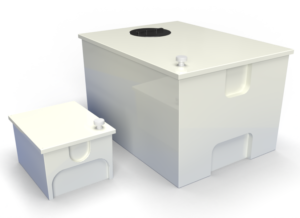
- Minimum: 45 litres
- Standard range: 45 to
6,000 litres - Maximum: 16,000 litres
- Bespoke sizes available
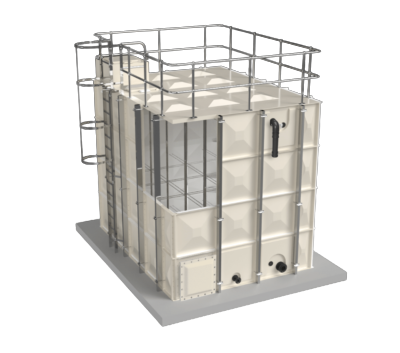
- Metric panels: 1m modular format
- Available in half-panel increments
(e.g., 6.65m × 4.65m × 2.5m height) - Maximum height: 4m
- No restrictions on length or width
Bespoke tanks
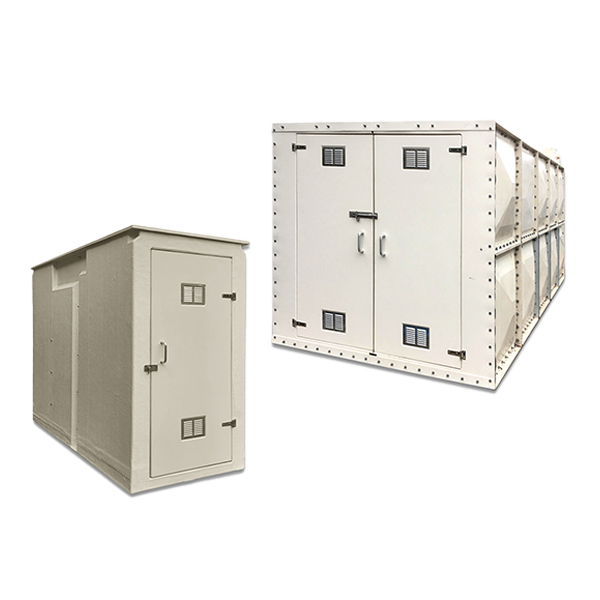
- Non-standard aspect ratios
- L-shaped or U-shaped
plan configurations - Internal access galleries
- Non-standard connection
positions
Sectional Tank Base Configurations
EFB — Externally Flanged Base
- Base flanges external to tank footprint; tank supported on raised beams or piers
- Advantage: Complete drainage; full inspection of base panels; air circulation under tank
- Best suited for: New-build plant rooms with adequate floor-to-ceiling height; compliance-critical potable applications
IFB — Internally Flanged Base
- Base flanges internal to footprint; tank sits on continuous flat floor slab
- Advantage: Lower overall height; no raised plinth required
- Best Suited for: Rooms with restricted headroom; the base does not fully gravity-drain and requires pumping to empty completely
TIF — Totally Internally Flanged
- All flanges internal; tank can be positioned against two perpendicular walls
- Advantage: Maximum space efficiency; full wall-to-wall installation possible
- Best suited for: Plant rooms where floor area is severely constrained; clearance required on two remaining sides only
EFB (Externally Flanged Base) is the preferred configuration for potable water applications where plant room height permits. It provides complete gravity drainage, full inspection of base panels, and air circulation beneath the tank — all of which support thorough cleaning and Legionella control
Insulation
For potable cold water storage, maintaining stored water below 20°C is a Legionella control requirement. Whether insulation is required depends on the ambient temperature of the installation location. Warm plant rooms — including basement service areas, roof spaces exposed to solar gain, and any location adjacent to heat-generating plant — will cause stored water to rise above 20°C in an uninsulated tank during warm weather.
Pre-Insulated (Integrated)
- Panels tank panels have polyurethane foam directly bonded and fully encapsulated within the GRP laminate during manufacture.
Externally Applied Insulation
- For large sectional tanks where factory-applied insulation adds prohibitively to panel weight or transport cost, external insulation applied after assembly is an alternative.
05
Sizing a Sectional GRP Cold Water Tank correctly
Sizing Sectional GRP Cold Water Storage for Infrastructure Projects
Sectional GRP cold water tanks for infrastructure projects must be sized according to the demand the stored water must meet and the conditions under which that demand must be met. The calculation requires the specifier to establish:
- The peak daily demand for the building or served zone
- The duration of storage required (reflecting the consequences of supply interruption and the reliability of the mains feed)
- Any additional reserves required for firefighting, process cooling, or other dedicated uses that must not deplete the general supply
- Any regulatory or sector-specific minimum storage requirements applicable to the building type
CIBSE Guide G (Public Health and Plumbing Engineering) provides the authoritative demand estimation methodology for UK building types, including per-capita cold water consumption figures that form the starting point for sizing calculations. The current edition of CIBSE Guide G should be used and its figures verified against the specific occupancy and use of the building under design.
|
Building type
|
Indicative cold water demand
|
Demand profile characteristics
|
|---|---|---|
|
Office (standard)
|
40–50 L/person/day
|
Concentrated in working hours; predictable daily profile; moderate holiday reduction
|
|
Healthcare (hospital)
|
180–350 L/bed/day (potable; varies by specialty)
|
Continuous; high clinical use; minimal demand reduction at night; holiday period demand approximately similar to term
|
|
School (primary/secondary)
|
20–40 L/pupil/day during term
|
Very high peak demand during break and lunch periods; near-zero demand during evenings, weekends, and holidays
|
|
Hotel
|
150–250 L/bed/day
|
High peak in morning; laundry and F&B loads significant; relatively predictable by season
|
|
Data centre (potable)
|
Based on occupancy — typically modest
|
Process cooling and fire suppression separately sized; potable demand driven by staff occupancy
|
|
Retail/leisure
|
Variable; WC and café/kitchen loading dominant
|
High peak at busiest trading periods; low overnight
|
|
Industrial/manufacturing
|
Process-driven; site-specific
|
Derive from process data rather than per-capita figures
|
Storage Duration
reserve. This reflects the historical reliability of the UK mains supply and is consistent with CIBSE Guide G and established good practice.
Deviation from the 24-hour standard may be appropriate in specific circumstances:
48-hour or 72-hour reserves are appropriate for buildings where supply interruption has severe consequences — hospitals, data centres, high-security facilities. This is a risk management decision that should be documented and approved by the client or their appointed advisor.
Reduced reserves may be appropriate for buildings on particularly reliable private supply infrastructure, but only where reliability is documented and the risk of interruption has been formally assessed.
Break tanks sized primarily to match booster pump set capacity rather than full daily demand — applicable where the tank function is hydraulic separation rather than demand reserve.
Oversizing cold water storage is a Legionella risk, not a safety margin. A tank sized on notional maximum occupancy that rarely sees its full stored volume turn over will develop stagnant zones. Size to realistic demand and manage turnover through configuration, not excess capacity.
Firefighting Reserve
Where a fixed automatic sprinkler system is installed, BS EN 12845 requires an independent water supply reserve sufficient to supply the system at its design flow rate for the specified duration. Duration depends on the system category (typically 30, 60, or 90 minutes) and hazard classification of the protected occupancy. The firefighting reserve must be maintained separately from the general cold water supply reserve — in a dedicated tank or in a clearly divided section of a shared tank — and must not be available to normal building demand.
The firefighting reserve must be physically separated from the general potable supply in all cases. A single undivided tank holding both is non-compliant with BS EN 12845. The sprinkler system designer and cold water engineer must coordinate at RIBA Stage 2 — not at tender stage.
06
Installation, Access and Structural Considerations
Installing cold water storage Tanks for Infrastructure Projects
Plant Room Access Assessment
Before a tank configuration is finalised, the access route from the building delivery point to the installation location must be assessed in detail. This assessment — which must be completed before procurement, not after delivery — should record the clear opening dimensions at every doorway, corridor, stairway, lift, service hatch, and roof opening on the route, and should confirm the structural load capacity of any floor or platform traversed by the delivery.
Structural Floor Loading
A filled cold water storage tank imposes a significant load on the supporting floor or structure. The magnitude of this load must be assessed by a structural engineer before the tank is installed; this is not an optional step for large tanks.
Water has a density of 1,000 kg/m³ (1 kg per litre)
A sectional tank with internal dimensions 4m × 4m × 2m depth holds 32,000 litres. The water alone exerts a load of 32,000 kg (32 tonnes) uniformly distributed across the tank footprint of 16m². This equates to 2,000 kg/m² — equivalent to approximately 20 kN/m² — before accounting for the tank self-weight or any dynamic loading from filling and emptying. Standard commercial floor slabs are typically designed for 2.5–7.5 kN/m². Structural assessment is essential.
Foundation Requirements
Sectional GRP tanks require a flat, level, and structurally adequate foundation. The permissible deviation from level varies by manufacturer and tank size; typical tolerances are in the range of ±2mm over the full tank footprint. Any deviation beyond the specified tolerance introduces uneven stresses into panel joints, which over time causes joint sealant failure and potential leakage or structural compromise.
Foundation levelness is the single most common cause of premature sectional tank joint failure. A deviation of only a few millimetres across a large tank footprint introduces unequal panel joint loading that progressively works sealant loose. This failure mode is not covered by most product warranties if installation records cannot demonstrate that the foundation was within tolerance.
07
Sector Considerations
Cold Water tank Storage across different UK Infrastructure sectors
Healthcare buildings are governed by NHS England Health Technical Memorandum HTM 04-01 (Safe Water in Healthcare Premises) alongside the general statutory framework of ACoP L8 and HSG274. HTM 04-01 is specific to NHS England premises; NHS Scotland, NHS Wales, and Health and Social Care in Northern Ireland each publish equivalent guidance which must be consulted for projects in those jurisdictions.
Specification Requirements
- AB air gap (Category 5) protection
- Pre-insulated tanks
- Duty-standby
- Higher inspection and cleaning frequency
- Segregated potable and non-potable supplies
- Documented water safety plan covering all water systems in the premises
Cold water storage in educational buildings is governed by the same statutory framework as commercial buildings — ACoP L8, HSG274, and the Water Supply (Water Fittings) Regulations — with additional guidance from the Department for Education (DfE). Building Bulletin 93 (BB93) is the DfE reference document for school building design; the current edition should be consulted for water services guidance specific to educational buildings.
Specification Requirements
- Holiday stagnation – The written control scheme must include a flushing protocol for the beginning of each term
- Realistic sizing – Size on term-time demand and manage stagnation risk through protocol rather than oversizing
- Vulnerable users – Children’s susceptibility to waterborne illness is higher than the adult average
Data centres require three independent cold water storage functions — potable supply, firefighting reserve, and process cooling make-up — each specified, sized, and maintained separately. Plant rooms routinely exceed 25–30°C in warm weather, so maintaining stored water below 20°C demands effective insulation (pre-insulated panels 50mm polyurethane foam) verified by temperature monitoring at multiple levels within the tank.
Specification Requirements
- Tier III and Tier IV data centres require duty-standby configurations with automatic changeover and independent feed pipework
- Sprinkler storage requirements must be confirmed at RIBA Stage 2
- Firefighting reserves in data centres are typically larger than comparable commercial buildings
Buildings where the highest occupied floor is more than approximately 25 metres above the mains connection point use intermediate cold water storage and booster sets to maintain acceptable distribution pressure. The break tank at the booster set prevents direct mains connection; separate zonal tanks or further booster stages manage pressure in the upper floors of very tall buildings. For higher-risk residential buildings Accountable Persons have defined duties
Specification Requirements
- Break tanks at booster sets prevent direct mains connection
- Buildings above 18 metres are subject to the Building Safety Act 2022
- Water safety falls within the scope of building safety for higher-risk residential buildings
- The Accountable Person is legally required to ensure that Legionella risk assessment and control are properly managed and documented
Airports, railway stations, and major motorway service areas require cold water storage at scale. High throughput drives significant daily demand and firefighting reserves can be considerable. Continuous operation restricts maintenance windows, requiring duty-standby configurations; supply interruption has immediate consequences for large numbers. Oversight spans multiple bodies — the Civil Aviation Authority, Office of Rail and Road, and local authority environmental health officers.
Specification Requirements
- Scale with large passenger throughput
- Maintenance access in 24/7 transport facilities may be severely restricted
- Consequence of failure is high – the water storage specification should reflect this in resilience terms
- Regulatory oversight — airports and railway stations are subject to regulation from multiple bodies (CAA, ORR, local authority EHOs) as well as the standard water and health and safety framework
Industrial and manufacturing water storage requirements vary widely by sector, requiring careful specification. GRP tanks are suitable for many applications, but chemical compatibility must be verified for non-standard contents. Systems must separate potable and non-potable supplies to prevent cross-connection. Process cooling and fire suppression introduce additional technical demands, including temperature resistance and certification. Compliance with regulatory is essential.
Specification Requirements
- GRP suitability — confirm chemical compatibility for non-standard contents
- Potable vs non-potable — separate systems; clear labelling required
- Process cooling — higher temperatures or chemicals may limit standard GRP use
- Fire suppression — large reserves; LPCB-certified tanks to BS EN 12845
- Regulation — oversight from Environment Agency and Health and Safety Executive
08
Operation & maintenance
Maintenance, Inspection and Lifecycle of GRP Water Storage Tanks
The building owner or person responsible for the premises has a legal duty under the Health and Safety at Work etc. Act 1974, implemented through ACoP L8 and HSG274, to maintain cold water storage assets in a condition that prevents or minimises Legionella risk.
This duty does not diminish over the life of the asset, and it cannot be discharged by delegating responsibility to a contractor without ensuring that the contractor is competent and that adequate oversight and record-keeping are maintained.
Inspection: Frequency and Scope
HSG274 Part 2 specifies minimum inspection frequencies:
- Routine visual inspection — at least annually for most commercial settings; at least every six months in higher-risk settings (healthcare, facilities with immunocompromised occupants, or where previous Legionella sampling has returned positive results).
- Full cleaning and disinfection — at least annually, or more frequently where the written risk assessment identifies elevated risk.
- Temperature monitoring — at a frequency specified in the written control scheme; typically weekly or monthly cold water temperature checks at representative points in the distribution system.
Whole-Life Cost
A correctly specified and maintained GRP sectional tank has a higher initial capital cost than an equivalent galvanised steel tank. The relevant investment decision for infrastructure projects, however, is whole-life cost — the sum of capital cost, installation, maintenance, and end-of-life replacement, discounted to a common base over the planned asset life.
The principal cost advantages of GRP over galvanised steel over a 30-year asset life are:
- Lower maintenance cost — no coating maintenance; no rust treatment; no relining programme
- Lower contamination risk — no corrosion particulates; reduced biofilm risk from smooth internal surface; lower bacteriological remediation costs
- Longer service life — a well-maintained GRP tank outlasts galvanised steel under equivalent conditions; replacement programme deferred
- Modular repairability — individual panels in a sectional tank can be replaced without replacing the entire tank; a galvanised steel tank typically requires full replacement when the coating fails
When to Replace Rather Than Repair
There is no defined maximum service life for a GRP cold water storage tank; a well-maintained tank may remain serviceable beyond 30 years. The decision to replace rather than repair should be based on a condition survey and should consider:
- Structural integrity — widespread laminate thinning, panel joint failure, or corrosion of internal support steelwork beyond economical repair
- Persistent microbiological contamination — consistently positive Legionella sampling despite thorough cleaning and disinfection, indicating a surface that can no longer be reliably cleaned
- Regulatory non-compliance — a tank lacking Regulation 4 certification that cannot be retrospectively certified may require replacement to achieve and maintain compliance with the Water Supply (Water Fittings) Regulations
- Changed demand — a tank materially oversized or undersized for current building demand, creating a chronic Legionella or supply risk
- Operational economics — a whole-life cost assessment demonstrating that the ongoing maintenance cost of repair exceeds the amortised cost of replacement
Regulatory basis: The Confined Spaces Regulations 1997 (UK) require that entry into a confined space — including water storage tanks — is only carried out by competent persons, under a safe system of work.
A trained attendant must remain outside the confined space at all times during entry, maintaining communication with the entrant and holding the PTW
Case study — Greatworth Green Tunnel; Chipping Warden Green Tunnel, Northamptonshire
Installation of GRP Cold Water Tanks for HS2 Green Tunnel Projects
Tricel Water supplied and installed two large-capacity sectional GRP cold water storage tanks for HS2’s Green Tunnel programme in Northamptonshire, with a third scheduled for 2026. Each tank holds 224,000 litres, giving a total project capacity of 672,000 litres across three tanks. Assembled within the access constraints of active construction sites at Greatworth Green and Chipping Warden Green, both installations were completed in 2025 without delay to HS2’s construction programme.
672,000
Litres total installed capacity across 3 sectional GRP tanks
Frequently asked questions
What standard governs GRP cold water tanks in the UK?
BS EN 13280:2001 (Specification for glass-reinforced thermosetting plastics (GRP) tanks for above-ground storage of cold potable water) is the governing product standard. It covers material composition, structural performance, dimensional tolerances, testing requirements, and hygiene suitability. Compliance with BS EN 13280:2001 is a prerequisite for Regulation 4 certification of GRP cold water storage products in the UK. The currency of the standard should be confirmed before specification.
What does Regulation 4 compliance mean for a GRP cold water tank?
Regulation 4(1)(a) of the Water Supply (Water Fittings) Regulations 1999 requires that no water fitting shall be used unless it is of an appropriate quality and standard. For cold water storage tanks used in potable water applications, this means the tank and its materials must be independently tested to BS 6920:2000 and certified by a recognised third-party body. Kiwa certification is a recognised route to Regulation 4 compliance; Tricel Water products carry Kiwa certification. Most water undertakers require evidence of Regulation 4 compliance as a condition of mains connection, and most professional specifications mandate it as non-negotiable. Certification status must be verified at the time of specification — certificates can lapse — and the certificate number must be recorded in the project specification and the building O&M manual.
What is the maximum storage temperature for a Regulation 4 compliant GRP tank?
The maximum tested storage temperature under Regulation 4 certification (BS 6920) for a GRP cold water storage tank is 23°C. Above this temperature, the tank is operating outside its tested parameters and compliance cannot be assumed. For Legionella control purposes under ACoP L8 and HSG274 Part 2, cold water must be stored and distributed at or below 20°C. The 20°C ACoP L8 limit is the operative design criterion; the 23°C Regulation 4
parameter is a product testing boundary, not a temperature target.
How is cold water storage capacity calculated for an infrastructure project?
The calculation follows four steps: (1) Estimate daily cold water demand using CIBSE Guide G per-capita figures calibrated to the building’s specific occupancy type and headcount. (2) Select storage duration — typically 24 hours for commercial buildings, 48–72 hours for critical infrastructure such as hospitals and data centres. (3) Calculate and separately size any firefighting reserve required by the sprinkler system designer under BS EN 12845. (4) Check turnover — confirm that the entire stored volume will turn over within 24 hours under realistic demand conditions to manage Legionella risk. The worked example in Appendix C illustrates this process.
What does ACoP L8 require for cold water storage tanks?
ACoP L8 requires duty holders to: carry out a written Legionella risk assessment of all water systems including cold water storage; implement a written control scheme covering inspection, cleaning, temperature monitoring, and corrective actions; appoint a competent Responsible Person; and maintain records for a minimum of five years. For cold water storage tanks specifically, ACoP L8 requires stored water to be maintained at or below 20°C, stagnation to be minimised through adequate turnover, and tanks to be inspected and cleaned at defined frequencies. Failure to comply with ACoP L8 is taken as evidence of non-compliance with the Health and Safety at Work etc. Act 1974 in enforcement proceedings.
What are the different base configurations for sectional GRP tanks?
Three configurations are available. An Externally Flanged Base (EFB) tank has base flanges outside the tank footprint; the tank is elevated on beams or piers, allowing complete gravity drainage and underside access for inspection. An Internally Flanged Base (IFB) tank sits directly on a flat floor slab with base flanges inside the footprint; it cannot fully gravity-drain and requires pumping to empty completely. A Totally Internally Flanged (TIF) tank has all flanges internal, enabling it to be positioned against two perpendicular walls in severely constrained plant rooms; clearance must be maintained on the remaining two sides.
When is a Type AB air gap required instead of a Type AG air gap?
A Type AB air gap (Category 5 backflow protection) is required wherever the water stored in the cistern is at risk of contamination from a Category 5 fluid source — defined in the Water Supply (Water Fittings) Regulations 1999 as fluid presenting a serious health hazard through the presence of pathogenic micro-organisms, radioactive or very toxic substances. In practice, this means healthcare buildings (where it is mandated by HTM 04-01), facilities handling hazardous biological or chemical materials, and any installation where a Category 5 fluid risk assessment confirms the requirement. The alternative Type AG air gap provides protection only against Category 1–4 fluid risk and is not adequate where Category 5 risk exists.
How often must a cold water storage tank be cleaned?
HSG274 Part 2 specifies a minimum of annual cleaning and disinfection for most commercial settings. Higher-risk settings — healthcare buildings, premises with immunocompromised occupants, and any installation where previous Legionella sampling has returned positive results — require cleaning at least every six months. The precise frequency must be determined by the site Legionella risk assessment and documented in the written control scheme. Both the risk assessment and the control scheme must be reviewed whenever there is a material change to the water system or when monitoring results indicate that control limits are being exceeded.
When is LPCB certification required for a GRP cold water tank?
LPCB (Loss Prevention Certification Board) certification is required whenever a cold water storage tank serves a fixed automatic sprinkler system
designed to BS EN 12845. The certification, issued under LPS 1276, confirms that the tank meets the structural and material requirements for a firefighting water reserve. LPCB certification and Regulation 4 compliance (Kiwa certification) are separate; a tank serving combined potable and firefighting storage must hold both. Current LPCB status can be verified at redbooklive.com.
What is thermal stratification in a cold water tank and why does it matter?
Thermal stratification occurs when warmer, less dense water rises to the upper layers of a large storage tank while cooler water settles lower. In a plant room with heat gain, the upper layers of a tank larger than approximately 5,000–10,000 litres can exceed 20°C even when a single lowlevel temperature sensor shows an acceptable reading. This is significant because a recorded temperature below 20°C does not confirm compliance when only one sensor is present in a large, thermally stratified tank. Mitigation measures include specifying multiple temperature sensor pockets at low, mid, and high levels; internal baffles to direct flow and promote mixing; and positioning inlet and outlet on opposite sides of the tank to encourage end-to-end circulation.
What regulations apply to cold water tanks in Scotland and Northern Ireland?
Water fittings regulation is devolved. In Scotland, the applicable legislation is the Water Supply (Water Fittings) (Scotland) Regulations 2014 (SSI 2014/317), enforced by Scottish Water. In Northern Ireland, the Water Supply (Water Fittings) Regulations (Northern Ireland) 2009 (SR 2009/75), enforced by Northern Ireland Water. The substantive requirements — material suitability, backflow protection, overflow arrangements — are equivalent to the 1999 Regulations in England and Wales, but the correct instrument must be cited in project documentation. Citing only the 1999 Regulations for a project in
Scotland or Northern Ireland is technically incorrect.
RELATED TECHNICAL GUIDES
GO DEEPER ON THE TOPICS THAT MATTER
Each article in this series covers a specific aspect of cold water storage in infrastructure projects at full technical depth, with compliance references, worked examples, and checklists.
Technical Guide
How to Size Cold Water Storage Tanks (Step-by-Step UK Method)
Step-by-step guide to sizing cold water storage tanks in the UK. Covers 24-hour vs 48–72-hour storage philosophies, demand profiles by building type.
Technical Guide
GRP vs Steel vs Concrete Water Tanks (Material Comparison)
Compare GRP (fibreglass) vs steel vs concrete water storage tanks. Covers corrosion resistance, typical lifespan (20–40+ years), structural and installation differences.
Technical Guide
Tank Configuration Explained (Sectional vs One-Piece vs Bespoke)
Understand GRP water tank configurations: sectional (modular panel) tanks vs one-piece (monolithic) tanks, plus bespoke options. Covers dual-compartment and duty-standby.
Standards & Compliance
GRP Water Tank Compliance – UK Regulations, Standards & Best Practices
Comprehensive UK compliance guide for GRP cold water storage tanks. Covers the Water Supply (Water Fittings) Regulations 1999, Regulation 4.
Technical Guide
Maintenance, Legionella Control & Whole-Life Performance
Guide to maintaining cold water storage tanks for long-term performance. Covers routine inspection and cleaning.
Technical Guide
Installation & Structural Considerations for Water Tanks
Technical guide to installing water storage tanks safely in UK buildings. Covers plant room access planning and delivery logistics.
White paper — May 2026 · 70 pages
Sectional GRP Cold Water Tanks in UK Infrastructure Projects
The complete 78-page technical reference. Free to download.
Get in touch with Tricel Water
Speak to the
technical team about
your project
We supply and install sectional GRP cold water tanks across the UK — capacity from 1,000
litres to 4.6 million litres in high-rise commercial, residential, healthcare, and industrial buildings.
This guide is provided for general guidance and information purposes only. It does not constitute engineering advice and should not be relied upon as the sole basis for design decisions. © 2026 Tricel Water. All rights reserved.