Tank Assembly Components
Home » Product Guides & Comparisons » Sectional Tank Components
3D Training | Tank Assembly Components
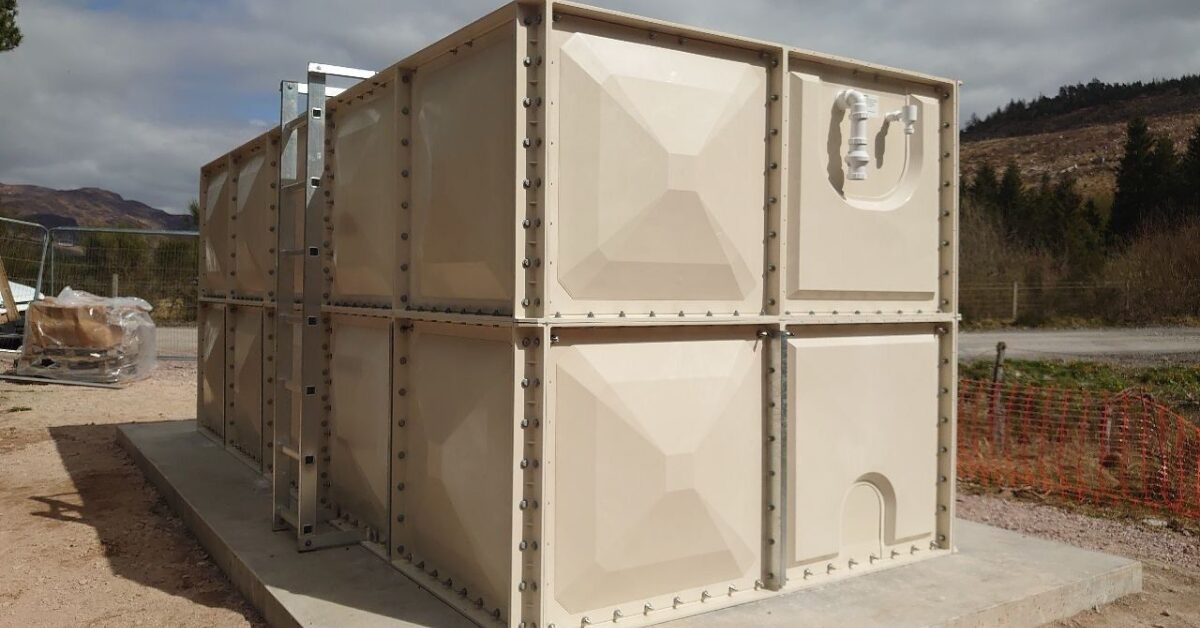
Take your knowledge to the next level with our cutting-edge 3D sectional GRP tank animation and immersive AR tool. As you engage with the model, you’ll discover the full range of tank assembly components—each clearly identified and explained so you understand exactly how and why they are used.
To further enhance your experience, access the Web AR feature located on the right-hand side of the 3D model. This allows you to virtually place the sectional tank within your plant room, offering a realistic perspective on how the components fit together in a real-world setting.
Ready to upskill? Dive into our interactive AR video below or start exploring the 3D model now to get hands-on with the complete array of tank assembly components.
Overview of Tank Assembly Components
Inlet Connection
This where water enters the tank.
There can be various types of inlet connections, i.e. Equilibrium Float Valve, Keraflo Float Valve, Tank Connection Only (with water flow controlled by level switches) or other control units such as TankTronic modules
Outlet Connection
This is where the water exits the tank.
Overflow Connection
The actual internal diameter of the pipe(s) installed should be capable of taking any possible flow in the pipe arising from any failure of the inlet valve.
Recommended that the overflow is 2x the inlet pipe diameter.
See Water Regulations 1999 sections 7.8 to 7.11 for further guidance.
Warning Pipe
The purpose of the warning pipe is merely to alert people to a fault and to an impending overflow.
Required on tanks with an actual capacity of 1000 litres or greater.
See Water Regulations 1999 sections 7.8 to 7.11 for further guidance.
Lid Support
A Lid support is designed to support lids on tanks that span over 1m in width and length.
Raised Inlet Valve Housing
Enables the inlet connection for the tank to be fitted at a higher level.
This could be due to the requirement for increased actual capacity, or ease of installing certain air gap requirements such as an AB air gap type.
External Ladder
Recommended where the height of the tank is greater than 1.5m.
Guardrail
Edge Protection designed to be fixed to the top of the tank to prevent the fall of any person who has to climb on top for maintenance purposes.
This has to be risk assessed by the site/designer/end user as a requirement if deemed necessary.
Access Manway
Standard Hinged or “lift off” options this will depend on the configuration of the tank.
Internal Ladder
Recommended where the height of the tank is 1.5m or greater.
Recommended for ease of access during maintenance/inspection.
Internal Tie Rods
S/S 316 Grade A4 internal ties brace the tank from outward water pressure.
On tanks, 1.5m high and greater, with a footprint of 1.5×1.0m and greater.
Stayplate
External bracing support for internal tie bars.
Required on certain tanks of 2.5m high and greater.
Drain Connection
A dedicated connection for draining contents of tank during maintenance/inspection.
Temperature Dial or Sensor
Available as either a visual dial readout or sensor to report back to BMS system.
Level Switch
High and/or Low. An electromechanical device that opens or closes a digital switch when the fluid in a given area reaches a certain level.
Commonly used to protect/control pump sets when low level is reached, or as an alarm warning when a high level is reached.
1x1m GRP Tank Panel
Hot Press Moulded 1m x 1m truncated tank panel, insulated as standard. Can be provided as an uninsulated option.
Where connections are being fitted to a tank that particular panel will be changed to a flat panel to accommodate.
1×0.5m GRP Tank Panel
Hot Press Moulded 1m x 0.5m tank panel, insulated as standard. Can also be provided as an uninsulated option.
0.5×0.5m GRP Tank Panel
Hot Press Moulded 0.5m x 0.5m tank panel, insulated as standard, but can be provided as an uninsulated option.
Primary Supports
For Externally Flanged Base tank, normally set @ 1000mm centres @ 600mm high.
Secondary Support
Steel used to cross Primary Supports where Externally Flanged Base tank is required to be supported @ 500mm centres, normally on Externally Flanged Base tanks of 2.5m high and greater.
Or where footprint configuration of the tank may cause access issues I.e. if there were a 0.5m increment on length/width two primary supports may end up too close together for safe access underneath.
Internal Maintenance Division
Construction of one or more panels within a tank which divides the tank into two separate compartments.
Note: In any situation where there is only one water storage tank in a building, it is to be recommend that a weir or a division plate be used. This will facilitate maintenance of the tank without affecting the water supply to the building.
AB Air Gap Spill Slot
Cat 5 Tanks, also known as Type AB Airgap Break Tanks (Category 5 Backflow Prevention)
Category 5 risks are fluids that pose a serious health risk due to the concentration of pathogenic organisms or extremely toxic or radioactive elements present with them including any fluid which contains; faecal material or other human waste: butchery or other animal waste: or pathogens from any other source.
Water Supply (Water Fittings) Regulations 1999 in England and Wales and Scottish Water Byelaws state the installation of cold water storage tanks, connected to the public water supply must comply with the UK water fitting regulations. In order to meet these requirements, Category 5 Break Tanks must be used.
1×0.5m GRP Tank Panel
Hot Press Moulded 1m x 0.5m tank panel, insulated as standard. Can also be provided as an uninsulated option.
0.5×0.5m GRP Tank Panel
Hot Press Moulded 0.5m x 0.5m tank panel, insulated as standard, but can be provided as an uninsulated option.
Primary Supports
For Externally Flanged Base tank, normally set @ 1000mm centres @ 600mm high.
Read More...
- Water Tank Installation & Maintenance
- Cold Water Storage Tanks
- Case Studies

Cold Water Tank Sizing: How to Calculate Storage Volume for Multi-Storey Buildings
A technical guide to cold water tank sizing methodology for multi-storey buildings — covering demand estimation, resilience calculations, water age, Legionella risk, and a worked sizing example.

Confined Space Entry in Building Maintenance: Obligations and Safe Systems
A practical guide to confined space entry obligations for building maintenance teams and contractors — covering the Confined Spaces Regulations 1997, permit to work, atmospheric testing, standby arrangements, and cold water tank entry.

Backflow Prevention in Building Water Systems: Fluid Categories and Device Selection
A technical guide to backflow prevention under the Water Fittings Regulations — fluid categories 1 to 5, device types for cold water cisterns, the Type AG air gap requirement, and common compliance failures.

Cold Water System Commissioning: Cleaning and Disinfection to BS EN 806-5
A practical guide to cold water system commissioning, cleaning, and disinfection in line with BS EN 806-5. Covers procedure, chlorination residuals, flushing, clearance for service, and handover documentation.