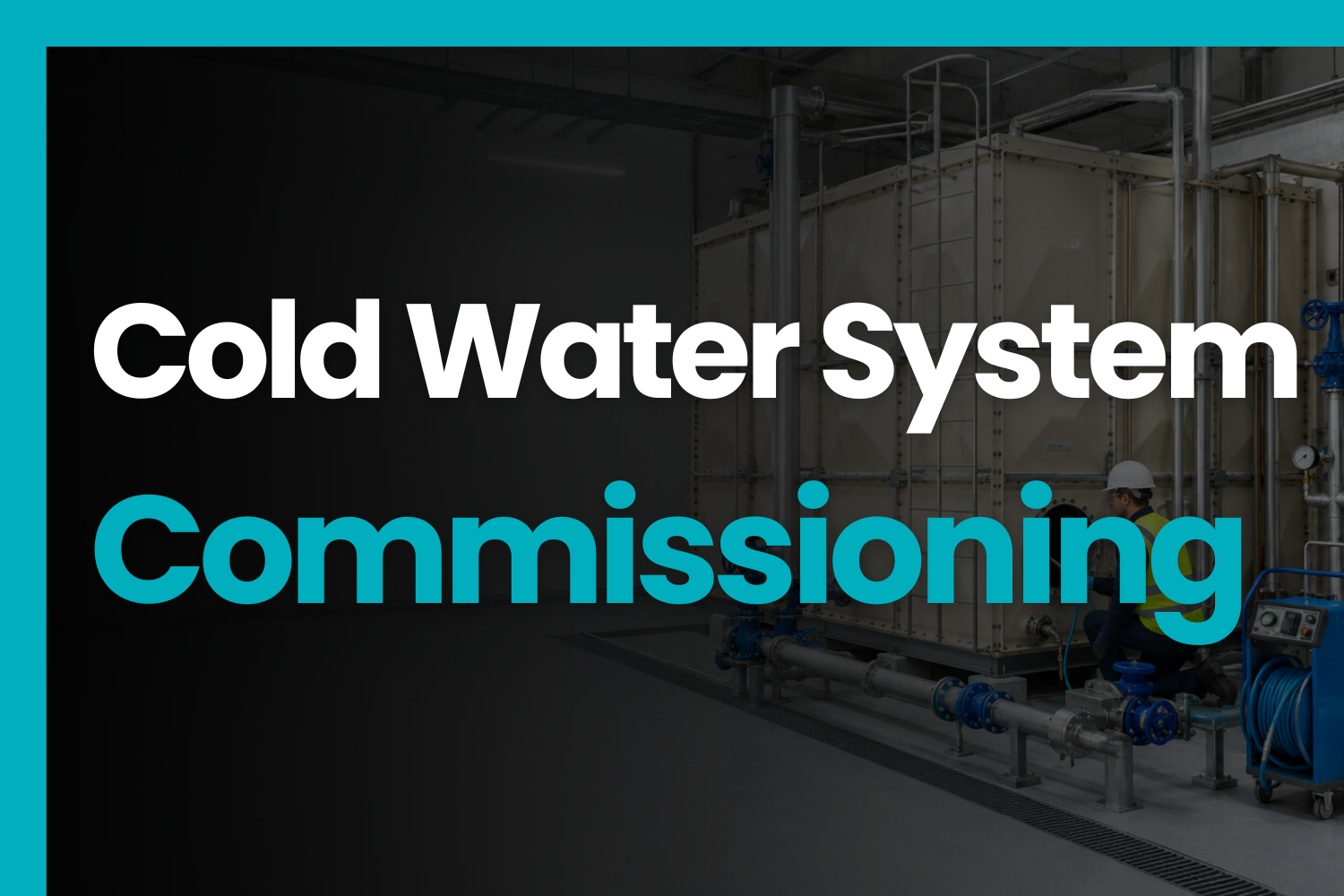
Cold water storage tanks accumulate contamination during construction and installation — swarf, construction dust, insulation debris, and biofilm from standing water in pipework. Without a thorough clean and disinfection procedure, these contaminants are delivered to building occupants from the moment the system enters service.
Commissioning is also when the compliance evidence is created. A signed disinfection certificate, a torque log, and completed functional test records are the documentary proof that the installation meets the Water Supply (Water Fittings) Regulations, that the tank has been assembled correctly to BS EN 13280, and that the system is safe for use. Without them, compliance cannot be demonstrated. For specification and installation of the tank itself, see the Complete Technical Guide to Sectional GRP Cold Water Tanks.
Minimum free chlorine concentration in tank during disinfection (BS EN 806-5 / HSG274 Pt 2)
Minimum contact time at 50 mg/L before draining and flushing
Target free chlorine range at outlets when system returns to service
Why commissioning matters
Legionella bacteria can colonise a newly filled water system rapidly under favourable temperature conditions. HSE guidance (HSG274 Part 2) confirms that disinfection should be carried out before any new or modified system is brought into use, and after any interruption to the water supply that may have led to contamination.
BS EN 806-5 requirement
BS EN 806-5:2012 requires that water supply installations are commissioned before being put into operation, and that commissioning includes cleaning and disinfection. It also specifies that commissioning records must be produced and retained. These are not discretionary steps — they are conditions of compliant handover.
The Drinking Water Inspectorate (DWI) references BS EN 806-5 in its guidance on landlord and building owner responsibilities. BS 8558, the complementary UK guidance document for domestic water services, also aligns with its requirements. Where a newly installed system is handed over without commissioning records, the building owner has no documentary basis on which to demonstrate that the system was safe at the point of first use.
Pre-commissioning — what must be in place first
Disinfection should not begin until the physical installation is complete and has passed a pre-commissioning inspection. Beginning the disinfection procedure before installation defects are corrected means conducting it again after those defects are remedied.
Do not proceed with defects outstanding
All items in the pre-commissioning checklist must be signed off before the first fill. Any defect identified during fill — particularly weeping joints — must be addressed before disinfection begins. Do not over-tighten joints to stop weeps; address the root cause.
|
Item
|
What to verify
|
|---|---|
|
Tank assembly
|
All panels, seals, and frames assembled per manufacturer drawings; no visible defects
|
|
Base and levelness
|
Level tolerance confirmed; structural support complete; no point loads
|
|
Connections
|
Inlet, outlet, overflow, warning pipe, and drain all connected, positioned, and supported
|
|
Air gap
|
Float valve positioned above overflow spillover level; air gap dimension measured and recorded
|
|
Covers and access
|
Close-fitting lockable covers installed; screened air vent in place; manway accessible
|
|
Insulation
|
Applied and sealed; vapour barrier on warm side; inspection points not obstructed
|
|
BMS connections
|
Level electrodes and temperature sensor pockets installed and wired
|
|
Booster set interface
|
Outlet vortex breaker installed; low-water cut-out electrode at correct level
|
|
Access and safety
|
Safe access platforms or handrails installed where required; lighting adequate
|
Related Guide
Covers the booster set interface requirements referenced in the pre-commissioning checklist – including vortex breaker specification. low-water cut-out interlocking, and MS signal requirements.
Initial fill and re-torque
Fill the tank in a controlled manner, observing all joints, connections, and the base. Any weeping joints must be addressed before proceeding.
After the initial fill, re-torque all bolts to the manufacturer’s specified torque values using a calibrated torque wrench. GRP panel seals compress slightly after first fill and thermal cycling; failing to re-torque is the most common cause of early joint leaks. Log all torque values on a torque log, recording each bolt position and the value applied. The torque log is a commissioning record and must be retained.
Schedule a second re-torque
A further re-torque check should be scheduled at four to six weeks after initial fill to account for ongoing seal settlement. Record and retain the results of this second check alongside the initial torque log.
Functional testing before disinfection
Before introducing disinfectant, carry out the following functional tests and record the results on a commissioning test sheet, signed and dated.
Float valve
Confirm the float valve closes at the design water level. Measure and record the air gap dimension — the vertical distance from the valve outlet to the overflow spillover level. This must meet the minimum requirement: 20 mm or twice the internal diameter of the inlet pipe, whichever is greater. The air gap is the sole compliant protection against Category 5 backflow at a cold water cistern inlet.
Overflow path
Simulate a high-water-level condition and confirm the overflow pipe discharges freely at the correct location. The discharge point must be visible and traceable — do not route to a concealed drain.
Warning pipe
Confirm the warning pipe discharges at the correct intermediate level — typically 25 to 50 mm below the overflow entry — before full overflow commences.
BMS signals
Verify that high-level, operational, low-level, and overflow alarm signals are correctly received and labelled in the BMS or local control panel.
Booster set low-water cut-out
Where applicable, confirm the low-level pump cut-out operates correctly. The booster set must be unable to run below the minimum water level — this is a mandatory protection feature, not an optional BMS signal.
Cleaning and disinfection procedure
The procedure follows the principles in BS EN 806-5 and HSG274 Part 2. All steps must be completed in sequence; skipping or abbreviating any step means the procedure must be repeated in full.
1. Physical clean of tank interior
Where applicable, confirm the low-level pump cut-out operates correctly. The booster set must be unable to run below the minimum water level — this is a mandatory protection feature, not an optional BMS signal.
2. Fill with potable water
Refill the tank with potable water to operational level. Disinfection is conducted on a full system.
3. Dose with sodium hypochlorite
Add sodium hypochlorite solution to achieve a minimum free residual chlorine concentration of50 mg/Lthroughout the tank — the concentration specified in BS EN 806-5 and referenced in HSG274 Part 2. Higher concentrations may be used where the system has been contaminated or where a risk assessment requires them.
4. Contact time and distribution
Allow a minimum contact time ofone hourat 50 mg/L. Circulate the water where possible to ensure the disinfectant reaches all parts of the tank, including the base and internal fittings. Where distribution pipework is connected, open all outlets progressively to draw disinfected water through to each outlet. Close each outlet once the chlorine residual is confirmed at that point.
5. Check residuals
Test the free chlorine residual at multiple points within the tank — low, mid, and high level — and at representative points in the distribution system. Record all readings. The minimum residual after contact time must still be at least 50 mg/L within the tank. If any point shows residual below this threshold, re-dose and extend contact time before proceeding.
6. Drain and flush
Drain the tank completely. Flush thoroughly with clean potable water until free chlorine at all outlets is within the acceptable range for potable supply — typically0.1 to 0.5 mg/L, or as specified in the contract or risk assessment. Record flush duration and final residual readings at each outlet.
7. Refill and confirm temperature
Refill the tank to operational level. Confirm temperature is at or below 20°C. Where required by the Legionella risk assessment or contract specification, take microbiological samples from the tank and representative distribution outlets before clearance for service.
Confined space requirements for tank entry
Entry into a cold water storage tank for cleaning or inspection is a confined space entry under the Confined Spaces Regulations 1997. The contractor performing the cleaning and disinfection must be able to demonstrate competence in confined space working — including current training records and a documented safe system of work for the specific tank — before any appointment is confirmed.
All entries require:
- A written safe system of work and a permit to work, specific to the tank entry
- Atmospheric testing — oxygen level, lower explosive limit, and toxic gases — before and during entry
- At least one trained standby person outside the confined space at all times
- Emergency rescue equipment and a trained rescue procedure in place before entry begins
- All entrants to hold appropriate confined space training and medical fitness to enter
Verify contractor competence before appointment
A signed method statement and risk assessment for confined space entry, together with evidence of current training records for all entrants, should be reviewed and approved before the cleaning contractor is appointed. Do not accept verbal assurances.
Microbiological sampling
Whether microbiological sampling is required before clearance for service depends on the project specification, the Legionella risk assessment, and the building type. Sampling should be considered as a minimum for:
- Healthcare premises, care homes, and other high-risk occupancies
- Systems that have been out of service for an extended period before commissioning
- Situations where the physical clean identified significant contamination or visible biofilm
- Where specified by the water company or the building contract
Samples should be submitted to a UKAS-accredited laboratory. The standard tests for cold water commissioning include total viable count (TVC) at 22°C and 37°C, Escherichia coli, coliforms, and Legionella where required by the risk assessment. The system should not be brought into unrestricted use until clearance is received from the laboratory.
Related Guide
Explains when microbiological sampling is required, wha the written control scheme must cover, and the documentation that must be in place before and after system handover.
Commissioning documentation and handover
Commissioning produces a set of records that must be compiled into a commissioning file and transferred to the building owner or facilities manager at handover. These records are the primary evidence of compliance and must be retained — as a minimum for five years, or per contractual requirements if longer.
An unsigned certificate has no evidential value
The disinfection certificate must be signed by the contractor who performed the work, not simply generated as a document. An unsigned or undated certificate cannot be relied upon to demonstrate that the procedure was completed correctly.
|
Document
|
Minimum Content
|
Responsible Party
|
|---|---|---|
|
Pre-commissioning inspection record
|
All checklist items signed off
|
Installer
|
|
Torque log (initial fill)
|
All bolt positions and torque values recorded
|
Installer
|
|
Functional test sheets
|
Float valve, overflow, warning pipe, BMS signals — results and sign-off
|
Commissioning engineer
|
|
Disinfection record
|
Date, chlorine doses applied, residuals at each test point, flush duration, final residuals
|
Disinfection contractor
|
|
Disinfection certificate
|
Signed statement confirming procedure, residuals achieved, and clearance for service
|
Disinfection contractor
|
|
Microbiological sampling results
|
Laboratory report from UKAS-accredited lab, with clearance confirmation
|
Laboratory
|
|
Post-settlement re-torque schedule
|
Confirmation of 4–6 week re-torque appointment and responsibility
|
Installer / FM
|
|
As-built drawings
|
Tank location, connections, overflow route, and BMS wiring
|
Design engineer / installer
|
Recommissioning after maintenance or shutdown
The same commissioning procedure applies when a cold water storage tank is returned to service after any of the following:
- Annual cleaning and inspection
- Any modification to the tank or connected pipework
- A shutdown exceeding approximately seven days
- An incident — overflow, contamination event, or structural defect — that may have compromised water quality
A building that has been unoccupied for several weeks or months requires particular care. Before recommissioning, flush all outlets, increase monitoring frequency in the initial period of reoccupation, and ensure the Legionella risk assessment has been reviewed to reflect the shutdown period. The written control scheme should specify the response to extended shutdown as a defined trigger event.
Annual cleaning cycle
BS EN 806-5 and HSE guidance (HSG274 Part 2) require cold water storage tanks to be cleaned and disinfected as a combined operation — not cleaned alone. Annual cleaning without disinfection does not satisfy the written control scheme requirement and does not constitute a complete maintenance cycle. The disinfection certificate must record both the cleaning and the disinfection steps as a single operation.
Frequently asked questions
What chlorine concentration is required to disinfect a cold water storage tank?
BS EN 806-5 and HSG274 Part 2 specify a minimum free residual chlorine concentration of 50 mg/L within the tank, with a contact time of at least one hour. The residual must be tested at multiple points — including low, mid, and high level — and must remain at or above 50 mg/L after the full contact time has elapsed. Higher concentrations may be specified for contaminated systems.
What free chlorine level is acceptable when the system returns to service?
After disinfection, the system must be thoroughly flushed until free chlorine at all outlets falls within the acceptable range for potable supply — typically 0.1 to 0.5 mg/L free chlorine. The exact acceptable range may be specified by the water company, the project contract, or the Legionella risk assessment. Confirm with the appointed water hygiene specialist before clearing the system for use.
Does a cold water tank need to be disinfected every time it is cleaned?
Yes. BS EN 806-5 and HSE guidance require that the tank is cleaned and disinfected as a combined operation. Cleaning without subsequent disinfection does not constitute a complete maintenance cycle and does not satisfy the written control scheme requirement. The disinfection certificate must record both the cleaning and the disinfection steps.
Who can perform cold water tank disinfection?
Disinfection must be performed by a competent contractor — one with demonstrable experience of cold water system disinfection, familiarity with BS EN 806-5 requirements, and the capability to conduct confined space entry safely in line with the Confined Spaces Regulations 1997. The contractor must be able to provide a signed disinfection certificate on completion and should be able to produce training records and a documented safe system of work for confined space entry on request.
What records must be kept after commissioning?
As a minimum: a pre-commissioning inspection record, a torque log, functional test sheets, a disinfection record with all chlorine residual readings, a signed disinfection certificate, and microbiological sampling results where applicable. All records should be retained for a minimum of five years, or per contractual requirements if longer.
CONTENTS
Free Download
Complete GRP Cold Water Tank Guide
Full lifecycle coverage — sizing, compliance, installation, Legionella control, and O&M schedules. Includes commissioning checklists and a maintenance log template.