Home » Fire Sprinkler Tanks
GRP Fire Sprinkler Water Storage Tanks
Tricel manufactures LPCB-approved GRP fire sprinkler water storage tanks certified to LPS 1276 Issue 2.0 and listed in the LPCB RedBook. Engineered for systems designed to BS EN 12845, BS 9251 and NFPA. Available in one-piece and sectional configurations — including TIF for restricted plant rooms and retrofit projects.
- •LPCB certified to LPS 1276 Issue 2.0 – listed in the LPCB RedBook
- •LPS 2070 LPCB-approved vortex inhibitor fitted where specified
- •BS EN 12845, BS 9251 and NFPA compatible – confirmed by the fire protection designer
- •One-piece and sectional (EFB, IFB, TIF) configurations available
- •GRP manufactured to BS EN 13280 – UK manufacturer, two production sites
- •Member of BAFSA — the British Automatic Fire Sprinkler Association
Sprinkler Tank — Key Parameters

LPCB certification
LPS 1276 Issue 2.0
RedBook listed
Yes - certificate available
Vortex inhibitor
LPS 2070 approved
Standards
BS EN 12845 / BS 9251 / NFPA
GRP standard
BS EN 13280:2001
Industry body
BAFSA member
Configurations
One-piece & EFB / IFB / TIF sectional
Insulation
Project-specific; confirm at spec stage
LPCB Certified — LPS 1276 Issue 2.0 & LPS 2070 Vortex Inhibitor
Listed in the LPCB RedBook. Certificate available to download. Third-party assurance for specifiers, insurers and authorities having jurisdiction.
What is a fire sprinkler water storage tank?
A fire sprinkler water storage tank is a dedicated cold water storage vessel that provides the water supply for an automatic fire sprinkler system. It ensures a reliable, independent supply of water is available for the required discharge duration, regardless of mains pressure or supply availability at the time of a fire event. In the UK, tanks for fire suppression duty must be LPCB approved and designed in accordance with the applicable standard — BS EN 12845 for commercial and industrial buildings, or BS 9251 for domestic and residential applications. Tricel manufactures LPCB-approved GRP fire sprinkler tanks certified to LPS 1276 Issue 2.0, listed in the LPCB RedBook, and fitted with LPS 2070 approved vortex inhibitors.
LPCB Certification - Manufacturer Credentials
LPCB-Approved Fire Sprinkler Tanks - Listed in the LPCB RedBook
Tricel Weston Ltd. fire sprinkler tanks are independently certified by the Loss Prevention Certification Board (LPCB) to LPS 1276 Issue 2.0 — the recognised standard for water storage tanks used in fire suppression systems. Certification is maintained through ongoing audit and verification, not as a one-time approval.
LPCB RedBook listing provides specifiers, insurers and authorities having jurisdiction (AHJ) with a searchable, third-party-verified record of the tank’s certification status. This is the assurance route that most UK property insurers and fire authorities expect for commercial and industrial fire protection projects.
Tricel Water UK is a member of BAFSA — the British Automatic Fire Sprinkler Association, the UK trade body for the fire sprinkler industry, representing the industry since 1974. BAFSA membership reflects Tricel’s engagement with UK fire sprinkler industry standards, best practice and compliance guidance relevant to its fire protection products.
1276 Issue 2.0
2070 Vortex Inhibitor
RedBook listed
13280 construction standard
The LPS 1276 certificate is available to download from Tricel’s website. Provide the certificate reference to your fire protection designer, insurer or AHJ at specification stage.
LPCB RedBook Listed
Searchable third-party certification record for specifiers, insurers and AHJs
LPS 1276 Issue 2.0
Current issue of the LPCB standard for fire suppression water storage tanks
LPS 2070 Vortex Inhibitor
LPCB-approved vortex inhibitor fitted to outlet as required by LPS 1276
Certificate Available to Download
Provide to your fire protection designer, insurer or AHJ at project stage
BAFSA Member
Tricel is a member of the British Automatic Fire Sprinkler Association, the UK trade body for the fire sprinkler industry
01
Applications
Where GRP Fire Sprinkler Tanks Are Specified
LPCB-approved GRP sprinkler tanks are specified across a wide range of building types and occupancies. The hazard classification and required storage volume vary by building use and system design — these must be confirmed by the fire protection engineer.
Healthcare & NHS
High-Rise & Multi-Storey
Infrastructure & Utilities
Fire Protection
Data Centres
Industrial & Manufacturing
Education
Agriculture
Food & Beverage
Local Authority & Public
The applicable standard, hazard classification and required storage volume vary by occupancy and system design. All three must be confirmed by the fire protection system designer before a tank is specified.
02
Applicable Standards
Standards Governing Fire Sprinkler Water Storage Tanks
The applicable standard depends on building type, occupancy, system design and insurer requirements. Tricel’s GRP fire sprinkler tanks are compatible with systems designed to the following standards — but the system design, including storage volume and flow requirements, must be confirmed by the fire protection engineer.
BS EN 12845
Automatic Sprinkler Systems — Commercial & Industrial
BS EN 12845 is the primary standard for automatic sprinkler systems in commercial and industrial buildings in the UK. It defines hazard classifications (Light Hazard, Ordinary Hazard 1–4, High Hazard), water supply requirements, flow rates, pressure requirements, system design and maintenance. Required storage volume is calculated from the hazard class, area of operation and required discharge duration.
BS 9251
Residential & Domestic Sprinkler Systems
BS 9251 applies to sprinkler systems for domestic and residential buildings — houses, flats, sheltered housing, care homes and similar. It specifies design, installation and maintenance requirements for smaller-scale systems where the hazard profile and water supply requirements differ from commercial applications. Storage and flow requirements are lower than BS EN 12845 for equivalent hazard categories.
NFPA Standards
NFPA 13, NFPA 14, NFPA 22
Where projects involve international insurers, US-based clients or buildings with US lease covenants, NFPA standards may apply. NFPA 13 covers automatic sprinkler systems; NFPA 14 covers standpipe and hose systems; NFPA 22 covers water tanks for private fire protection. Tricel tanks are compatible with NFPA-designed systems — confirm suitability with the fire protection designer.
LPS 1276
LPCB Standard for Sprinkler Water Storage Tanks
LPS 1276 is the LPCB certification standard for water storage tanks used in fire suppression systems. It specifies requirements for tank construction, performance, fittings, vortex inhibitor, LPCB information plate, overflow, drain and installation. Tricel tanks are certified to LPS 1276 Issue 2.0 — the current issue. Certification is maintained through ongoing LPCB audit.
LPS 2070
LPCB Approval for Vortex Inhibitors
LPS 2070 is the LPCB approval standard for vortex inhibitors used in fire suppression tanks. LPS 1276 requires an LPS 2070-approved vortex inhibitor to be fitted to the inlet of the outlet pipe. Tricel fits an LPS 2070 LPCB-approved vortex inhibitor as standard where specified. This prevents air ingress to the sprinkler system as the tank empties during a fire event.
BS EN 13280:2001
GRP Cold Water Storage Tank Standard
BS EN 13280 is the British and European standard for glass-reinforced plastic cisterns for cold water storage. Tricel manufactures its GRP fire sprinkler tanks with reference to this standard, ensuring panel construction, approved materials and smooth internal surfaces suited to fire protection duty.
The applicable standard for any specific project must be confirmed by the fire protection engineer, building control and insurer. The tank manufacturer’s role is to supply a tank that meets the certification and construction requirements of the standard — the system design, hydraulic calculations and storage volume are the responsibility of the fire protection designer.
03
Hazard Classification & Storage Requirements
BS EN 12845 Hazard Classification and Indicative Storage Volumes
BS EN 12845 classifies occupancies by fire hazard level. Each hazard class has different water supply requirements – flow density, area of operation, pressure and duration. These determine the minimum storage volume. The following table shows indicative occupancy examples and minimum storage volumes; all figures must be confirmed by the fire protection system designer from hydraulic calculations.
Design authority note: Storage volumes in this table are indicative only. The minimum storage volume for any specific project must be calculated by the fire protection engineer from the system hydraulic design, hazard classification, area of operation and water supply duration requirements of the applicable standard. Do not use these figures as the basis for a tank order without a confirmed hydraulic design.
|
Hazard Class
|
Typical Occupancies
|
Indicative Min. Storage
|
Key Characteristic
|
|---|---|---|---|
|
Light Hazard (LH)
|
Hospitals, hotels, libraries (excl. bookstores), restaurants, schools, offices, data processing offices
|
From ~9,000 L Subject to hydraulic design
|
Lower fire load; lower flow density and area of operation requirements compared with OH classes
|
|
Ordinary Hazard Groups 1–2 (OH)
|
Car parks, laundries, dry goods warehouses, paper/light manufacturing, breweries, printing (water-based inks), laboratories
|
From ~54,000 L Subject to hydraulic design
|
Moderate combustible content; increased flow density requirements; area of operation typically 100–260 m²
|
|
Ordinary Hazard Groups 3–4 (OH)
|
Broadcasting studios, railway stations, plant rooms, department stores, shopping centres, paper/cardboard factories, bookbinding
|
From ~135,000 L Up to ~185,000 L; subject to hydraulic design
|
Higher combustible content; greater area of operation and duration requirements; larger storage volumes typically required
|
|
High Hazard (HH)
|
Flammable liquid storage, aerosol storage, foam rubber manufacturing, certain timber and plastic processing
|
Project-specific Specialist design required
|
High fire load or rapid fire development; specialist system design; insurer involvement essential at early stage
|
|
Residential (BS 9251)
|
Houses, flats, care homes, sheltered housing, HMOs
|
From ~1,000 L Subject to BS 9251 design
|
Lower flow and storage requirements; BS 9251 design by specialist residential sprinkler designer; insurer confirmation required
|
Sprinkler Tank Size Calculator
Calculate indicative sprinkler tank storage volume
Tricel’s sprinkler and wet riser tank calculator provides an indicative starting capacity based on your hazard class, area of operation and duration inputs. Results must be verified against the system hydraulic design.
Sprinkler Tank — Key Parameters
Applicable standard
BS EN 12845 / BS 9251 / NFPA
Hazard classification
LH / OH1–4 / HH
Design area of operation
m² - from hydraulic design
Required flow density
mm/min - from hazard class
Required discharge duration
Minutes - from standard
Water supply category
Single / combined / category
Insurer requirements
Confirm before specifying
All inputs must be confirmed by the fire protection engineer. The tank manufacturer’s responsibility is to supply a tank to the certified specification — not to design the sprinkler system.
04
Tank Configurations
Fire Sprinkler Tank Configurations
Tricel supplies GRP fire sprinkler tanks in one-piece and sectional configurations. The appropriate type depends on required storage volume, installation access, plant room constraints and project programme. All configurations are available to LPCB LPS 1276 Issue 2.0 certification.
Smaller volumes / clear access
One-Piece GRP Sprinkler Tank
Delivered as a single moulded GRP unit. No on-site assembly required. Suitable where the access route allows the complete tank to be moved into position. Shortest installation time on site.
Certification
LPCB LPS 1276 Issue 2.0
Capacity range
Up to 16,000 L standard
Installation
Position and connect; no assembly
Access requirement
Clear route for complete unit
Large volumes / restricted access
GRP Sectional Sprinkler Tank (EFB / IFB)
Certification
LPCB LPS 1276 Issue 2.0
Capacity range
Panel access route
Perimeter clearance
500mm–1,000mm by height
Highly constrained plant rooms
TIF GRP Sectional Sprinkler Tank
TIF (Totally Internally Flanged) tanks are assembled from inside. Approximately 50mm clearance achievable on three sides; approximately 500mm on the pipework access side. For retrofit and replacement projects where standard perimeter clearance is not achievable.
Certification
LPCB LPS 1276 Issue 2.0
Three-side clearance
~50mm (design confirm)
Pipework side
~500mm
Assembly
From inside by trained team
|
Requirement
|
One-Piece
|
Sectional EFB / IFB
|
TIF Sectional
|
|---|---|---|---|
|
Storage volume
|
Up to ~16,000 L standard
|
1,000 L to 4M+ L
|
1,000 L to 4M+ L
|
|
Access route
|
Clear continuous path required for complete unit
|
Individual panels via 750mm+ doorways; corridors; stairwells
|
Panels assembled from inside; ~50mm clearance on 3 sides
|
|
Installation time
|
Shortest
|
Moderate
|
Moderate
|
|
Retrofit suitability
|
Access-dependent
|
Strong option
|
Highly constrained
|
|
LPCB LPS 1276
|
Yes
|
Yes
|
Yes
|
05
Vortex Inhibitor
LPS 2070 LPCB-Approved Vortex Inhibitor
A vortex inhibitor is a critical component of a fire sprinkler tank. As the tank empties during a fire event, a vortex can form at the outlet — drawing air into the sprinkler pipework and disrupting flow and pressure at the point when they are most needed.
LPS 1276 requires an LPCB-approved vortex inhibitor to be fitted to the inlet of the outlet pipe. Tricel fits an LPS 2070 LPCB-approved vortex inhibitor as standard on fire sprinkler tanks where specified, ensuring this critical component carries the same LPCB certification as the tank itself.
Prevents air ingress to sprinkler system as the tank empties during a fire event
LPS 2070 LPCB approval — matches the LPS 1276 certification of the tank
Fitted to the inlet of the outlet pipe as required by the LPS 1276 standard
Maintains stable flow and pressure throughout the discharge duration
Required on both one-piece and sectional GRP fire sprinkler tanks
Confirm vortex inhibitor specification at the quotation stage. LPS 1276 requires an LPS 2070-approved device; specifying a non-approved vortex inhibitor may affect the LPCB certification status of the complete tank assembly.
06
Why GRP for Fire Duty
Why GRP for Fire Sprinkler Water Storage?
GRP is the most widely specified material for fire sprinkler water storage tanks in the UK. The following characteristics make it well suited to fire protection duty.
Corrosion resistance
No internal corrosion products
GRP does not corrode in the way that steel does. This removes the risk of corrosion products entering the sprinkler system, blocking sprinkler heads or damaging pump components — a known failure mode with older steel tanks.
Low maintenance
Minimal ongoing maintenance requirement
GRP fire sprinkler tanks have a long service life with minimal routine maintenance requirements once installed and commissioned. Tricel GRP tanks have an average lifespan of 20–25 years, providing a long-term fire protection asset.
Lightweight panels
Manageable for restricted access
GRP panels are significantly lighter than steel panels of equivalent size, making them easier to manoeuvre through access routes, stairwells and corridors during installation — important for large-capacity fire tanks in restricted plant rooms.
Smooth internal surface
Suitable for fire water storage quality
The smooth, non-porous internal surface of GRP resists sedimentation and biological growth. This is particularly important for fire water storage, where long-term water quality and system readiness must be maintained.
Configurable
Flexible dimensions for fire duty
GRP sectional tanks can be configured to the exact dimensions required by the fire protection design — length, width and height determined by the required storage volume, available plant room space and clearance requirements.
UK manufactured
Consistent quality and short lead times
Tricel manufactures at two UK sites. Local manufacturing provides tighter quality control, full traceability and more predictable lead times than imported tank products — important for projects with time-sensitive fire protection sign-off.
GRP vs Steel
GRP Advantages
No internal corrosion • Lightweight panels • No internal painting • Non-porous surface • Modular sectional assembly • 20–25 year service life
Considerations vs Steel
Not suitable for very high temperatures • Bespoke repairs require specialist attention • Certain chemical combinations require material confirmation
07
Compliance & Insurer Requirements
Compliance for Fire Sprinkler Water Storage Tanks
Fire sprinkler tank compliance involves multiple parties: the tank manufacturer, the fire protection designer, the building owner and the insurer. The following checklist covers the key compliance considerations for specifiers and facilities managers.
Maintenance frequency schedule
LPCB certification to LPS 1276 Issue 2.0 confirmed
LPS 2070 approved vortex inhibitor specified
Hazard classification confirmed by fire protection engineer
Insurer requirements confirmed at design stage
LPCB information plate requirements confirmed
Tank commissioning and testing documented before handover
Tank listed in the LPCB RedBook
Applicable standard confirmed: BS EN 12845 / BS 9251 / NFPA
Storage volume from hydraulic design calculation
Authority having jurisdiction (AHJ) approval considered
Overflow arrangement compliant with water authority requirements
Maintenance access and inspection provision designed in
Why LPCB approval matters for insurers
Many UK property insurers require LPCB-approved sprinkler tanks as a condition of cover for commercial and industrial properties. A non-LPCB-approved tank may not be accepted by the insurer, potentially invalidating the fire protection system for insurance purposes.
Tricel’s LPCB RedBook listing means the certification can be independently verified by the insurer, AHJ or loss adjuster without relying solely on documentation from the manufacturer.
Insurer requirements vary. Some insurers specify additional requirements beyond LPS 1276 — confirm insurer acceptance of the full specification before placing the tank order. Changes to insurer requirements after manufacture may affect the project timeline.
Tricel provides LPCB certification documentation, RedBook listing details and BS EN 13280 compliance references on request. Available for inclusion in project O&M manuals, handover documentation and insurer submissions.
08
Technical Downloads
Fire Sprinkler Tank Technical Resources
Technical documents for fire protection engineers, M&E contractors, specifiers and facilities managers.
LPCB LPS 1276 Certificate
Current LPCB certification for Tricel fire sprinkler tanks — for insurer, AHJ and specification submissions.
Fire Sprinkler Tank Product Brochure
One-piece and sectional configurations, hazard class coverage, vortex inhibitor and specification guidance.
LPCB Fire Sprinkler Tank Whitepaper
Water storage for fire suppression systems — design considerations, standards, and performance insights.
09
Specification Support
Specify a Fire Sprinkler Water Storage Tank
The following information is needed to confirm the correct tank specification for your fire protection project. The storage volume and flow parameters must be confirmed by the fire protection engineer before the tank is ordered.
Information for a fire sprinkler tank quotation
Applicable standard (BS EN 12845 / BS 9251 / NFPA)
Required storage volume (litres)
Tank location (internal or external)
Access route constraints
Configuration preference (one-piece / sectional)
LPCB certificate required for project
Hazard classification
Required flow rate and duration
Available footprint and headroom
Insurer name and requirements
Vortex inhibitor specification confirmed
Drawings or plant room layouts available
Request a fire sprinkler tank quote
Tricel can review your fire protection project requirements and confirm the appropriate tank specification, LPCB certification status and delivery options.
Tricel provides LPCB certification documentation, RedBook listing details and BS EN 13280 compliance references on request. Available for inclusion in project O&M manuals, handover documentation and insurer submissions.
10
Project Experience
Fire Sprinkler Tank Project Experience
Tricel has supplied LPCB-approved GRP fire sprinkler tanks and water storage tanks across commercial, healthcare, educational and industrial projects in the UK. Our recent installations include:

Special educational needs school — LPCB sprinkler tank
LPCB-approved sectional GRP sprinkler tank installed at a special educational needs school to BS EN 12845 and BS 9251. Installation completed with minimal disruption on a sensitive site with restricted access.
Infrastructure project — large-capacity GRP sectional tanks
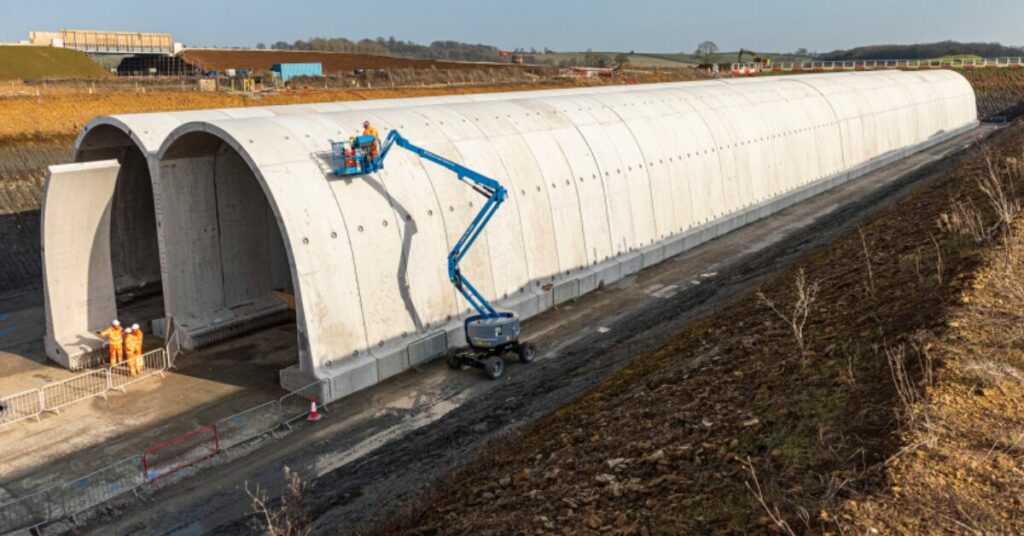
GRP water tanks (8m × 7m × 4m) manufactured and installed for two HS2 Green Tunnel sites at Greatworth and Chipping Warden, as part of the UK’s largest current infrastructure project.
Commercial building — 2 large potable water storage tanks
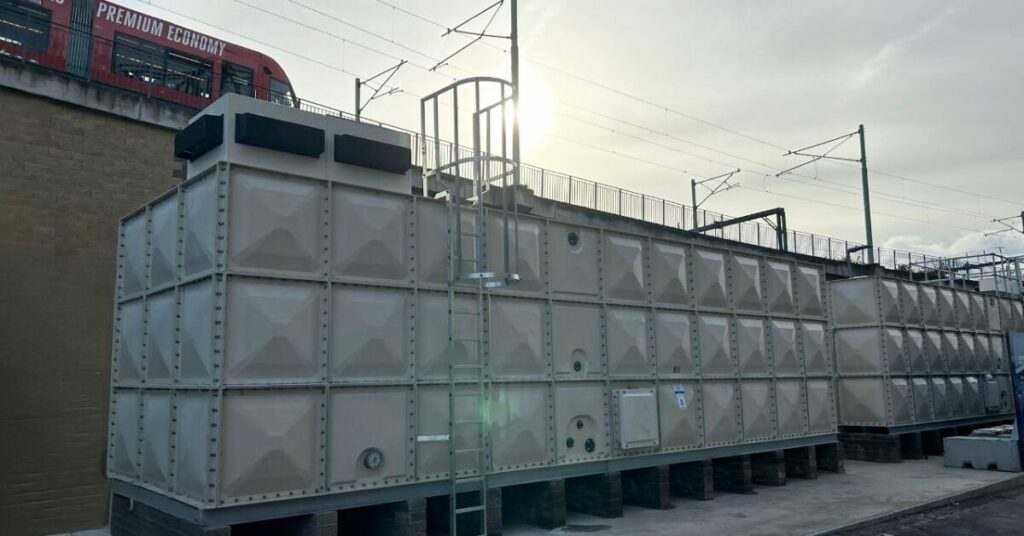
Two large GRP potable water storage tanks designed, manufactured and installed for Scottish Water Business Stream ahead of a major event. Completed ahead of schedule through close coordination between multiple stakeholders.
11
Related Resources
Fire Sprinkler Tank - Related Resources
Products, calculators, technical guidance and compliance resources for fire protection engineers, specifiers and M&E contractors.
Fire Protection Products
12
FAQs
Fire Sprinkler Water Storage Tank FAQs
Common questions from fire protection engineers, M&E contractors, specifiers and facilities managers.
What is a fire sprinkler water storage tank?
A fire sprinkler water storage tank is a dedicated cold water storage vessel that provides the water supply for an automatic fire sprinkler system. It ensures a reliable, independent supply of water for the required discharge duration, regardless of mains pressure or availability at the time of a fire event. Tanks for fire suppression duty must be LPCB approved to LPS 1276 and designed in accordance with the applicable standard — BS EN 12845 for commercial and industrial buildings, or BS 9251 for domestic and residential applications. Tricel manufactures LPCB-approved GRP fire sprinkler tanks certified to LPS 1276 Issue 2.0.
What is LPCB approval and why is it needed for sprinkler tanks?
LPCB (Loss Prevention Certification Board) approval confirms that a sprinkler tank has been independently tested and certified to LPS 1276, the LPCB standard for water storage tanks used in fire suppression. LPCB-approved tanks are listed in the LPCB RedBook, providing specifiers, insurers and fire authorities with third-party assurance. Many UK property insurers require LPCB-approved sprinkler tanks as a condition of cover; without certification, the fire protection system may not be accepted for insurance purposes. Tricel’s fire sprinkler tanks are LPCB certified to LPS 1276 Issue 2.0 and listed in the RedBook.
What is the difference between BS EN 12845 and BS 9251?
BS EN 12845 is the primary standard for automatic sprinkler systems in commercial and industrial buildings. It defines hazard classifications from Light Hazard through Ordinary Hazard Groups 1–4 to High Hazard, with specific water supply requirements for each. BS 9251 applies to sprinkler systems for domestic and residential buildings — houses, flats, care homes and similar. The storage and flow requirements under BS 9251 are generally lower than equivalent BS EN 12845 classifications. The applicable standard must be confirmed by the fire protection engineer for each specific project.
How much storage capacity does a fire sprinkler tank need?
The required storage volume depends on the hazard classification of the building, the design area of operation, the required flow density and the required discharge duration under the applicable standard. Indicative minimum volumes range from approximately 9,000 litres for Light Hazard applications to 135,000 litres or more for higher Ordinary Hazard groups. High Hazard requirements are project-specific and require specialist design. All storage volumes must be confirmed by the fire protection engineer from hydraulic calculations — do not select a tank capacity without a confirmed system design.
What is a vortex inhibitor and why is it required on a sprinkler tank?
A vortex inhibitor is a device fitted to the outlet pipe of a fire sprinkler tank to prevent a vortex forming as the tank empties during a fire event. Without it, a vortex can draw air into the sprinkler system, disrupting flow and pressure at the critical point when the system is discharging. LPS 1276 requires an LPCB-approved vortex inhibitor — approved to LPS 2070 — fitted to the inlet of the outlet pipe. Tricel fits an LPS 2070 LPCB-approved vortex inhibitor to its fire sprinkler tanks as standard where specified by the system design.
Can GRP sectional tanks be used for fire sprinkler duty?
Yes. Tricel manufactures LPCB-approved GRP sectional sprinkler tanks in EFB, IFB and TIF configurations. Sectional tanks are particularly suited to large-capacity fire storage, restricted-access plant rooms and retrofit projects where a one-piece tank cannot be installed. All configurations are available to LPCB LPS 1276 Issue 2.0 certification. The TIF configuration can be assembled with approximately 50mm clearance on three sides, making it viable for highly constrained plant rooms.
What is the difference between a sprinkler tank and a wet riser tank?
A fire sprinkler tank supplies water directly to an automatic sprinkler system that activates on detection of fire. A wet riser tank supplies water to a pressurised wet riser system providing fixed outlet points for fire service use at each floor. Both are dedicated fire water storage systems with different design requirements. The applicable standard, required storage volume and flow parameters for each are different and must be confirmed by the fire protection engineer. Tricel supplies tanks for both applications.
Are Tricel sprinkler tanks listed in the LPCB RedBook?
Yes. Tricel Weston Ltd. fire sprinkler tanks are LPCB certified to LPS 1276 Issue 2.0 and listed in the LPCB RedBook. The RedBook is a publicly searchable database of LPCB-approved products, providing specifiers, insurers and authorities having jurisdiction with independent confirmation of the tank’s certification status. The LPCB certificate is available to download from Tricel’s website.
What information is needed to quote a fire sprinkler tank?
Key information includes: the applicable standard (BS EN 12845, BS 9251 or NFPA); hazard classification; required storage volume from hydraulic calculations; flow rate and duration; tank location (internal or external); available footprint and headroom; access route constraints; insurer name and requirements; configuration preference; vortex inhibitor specification; and whether the LPCB certificate is required for the project submission. Storage volume and flow parameters must be confirmed by the fire protection engineer before the tank is ordered.
Do domestic fire sprinkler systems require the same LPCB approval?
Domestic and residential sprinkler systems are typically designed to BS 9251 rather than BS EN 12845. The LPCB certification and insurer requirements for smaller residential systems differ from commercial and industrial installations. Confirm the applicable standard, certification requirements and insurer expectations with the fire protection designer and, where applicable, with the local authority building control and insurer at an early stage of the project.
Tricel Fire Sprinkler Tanks - LPCB Certified Manufacturer
Specify an LPCB-approved GRP fire sprinkler tank
Send your hazard classification, required storage volume, applicable standard, insurer details and plant room constraints. Tricel will confirm the appropriate configuration, LPCB certification status and delivery options.
This product guide is provided for general guidance and information purposes only. It does not constitute engineering advice and should not be relied upon as the sole basis for design decisions. © 2026 Tricel Water. All rights reserved.