Home » Technical Guides » Sectional vs One-Piece vs Bespoke GRP Tanks: Configuration Guide
Tank Configuration Explained: Sectional vs One-Piece vs Bespoke GRP Tanks
Selecting the right GRP tank configuration — not just the right material — determines whether the system can be installed, maintained, and operated within the physical realities of the building. This guide explains the main GRP tank configurations: one-piece, sectional, and bespoke GRP tanks, including specialised base flange types and redundancy strategies for buildings requiring continuous supply.
- April 9, 2026
Consulting engineers · MEP contractors · Developers
BS EN 13280; WRAS requirements; ACoP L8
Approx. 10 minutes
This guide explains the principal GRP tank configurations available for UK building projects — one-piece, sectional, and bespoke — the three base flange types used in sectional installations, and the redundancy arrangements appropriate for buildings where continuous supply is critical. Configuration decisions are determined by capacity requirements, plant room geometry, access constraints, and maintenance strategy; the correct choice depends on building-specific conditions and must be confirmed by a suitably qualified engineer.
For the sizing methodology that determines the storage volume before a configuration is selected — including demand estimation, resilience calculations, and water age assessment — see the Cold Water Tank Sizing Guide for Infrastructure Projects.
Typical capacity range for one-piece GRP tanks — constrained by transport and access
Maximum achievable capacity for sectional GRP tanks — panels assembled on-site
Minimum underfloor and perimeter clearance required for EFB (externally flanged base) installations
One-Piece vs Sectional Tanks — What is the Difference?
One-piece tanks are seamless, single-unit structures manufactured in factory moulds and delivered ready to install. They are available in capacities from 45 to approximately 16,000 litres.
Key advantages
One-Piece Tanks
- Simplified installation: No on-site assembly — place, connect pipes, and commission.
- Enhanced hygiene: No joints or sealants means a significantly reduced risk of contamination, making one-piece tanks particularly suitable for potable water storage.
- Lower maintenance: Fewer components — no bolts to retighten, no gaskets to replace — and fewer potential points of failure.
- Suitable for tight spaces: Ideal for loft spaces, small enclosures, and locations with limited access where larger sectional assembly is impractical.
Limitations
Capacity and access ceiling
Physical size is constrained by what can be transported and manoeuvred into position. For capacities beyond approximately 16,000 litres, a one-piece tank becomes impractical for road transport and delivery through site openings. Above this threshold, a sectional arrangement is required.
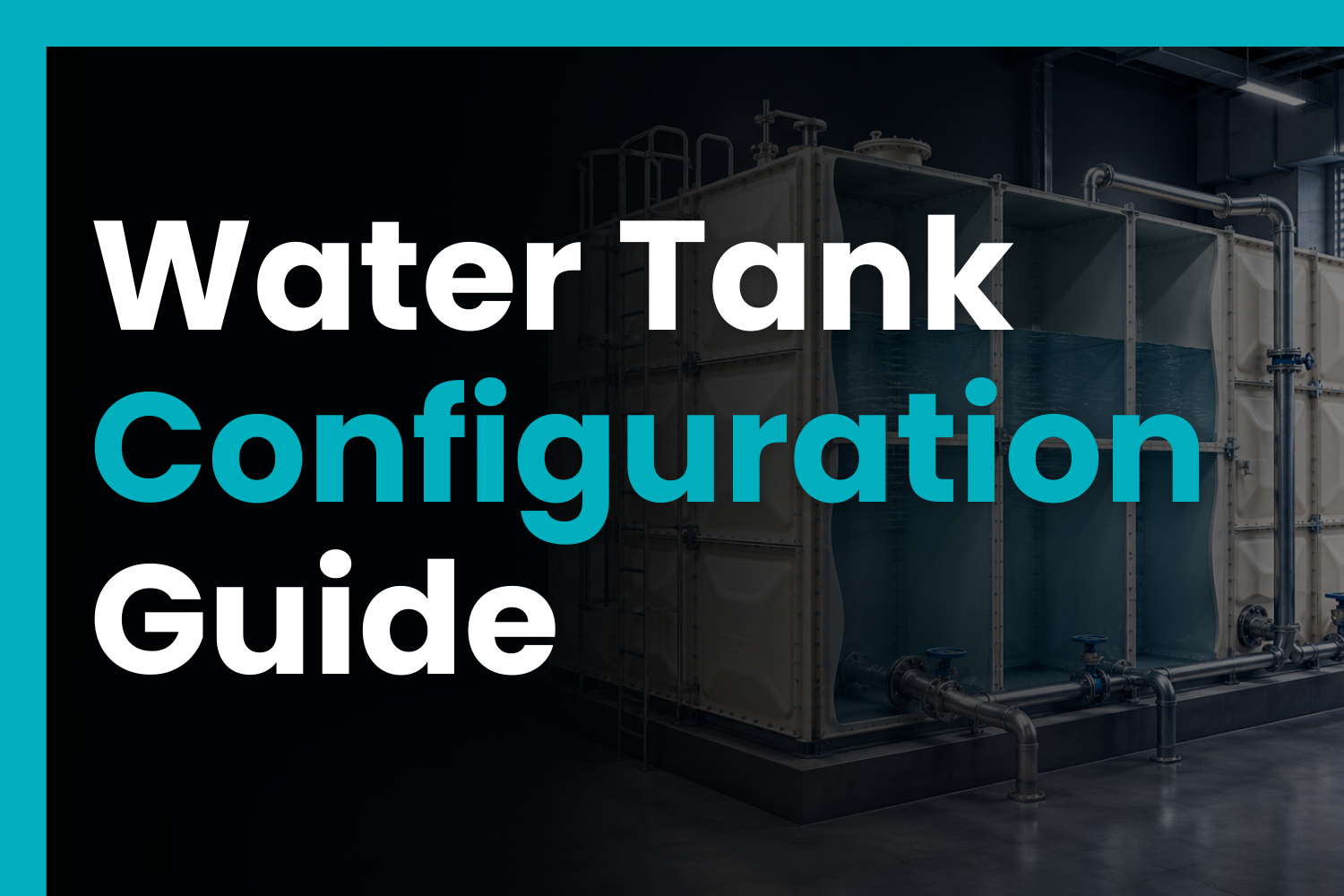
Sectional tanks are modular systems assembled on-site from interlocking GRP panels. Capacities range from 1,000 litres to over 4 million litres.
Key advantages
Sectional Tanks
- Virtually unlimited capacity: The modular approach allows construction of very large storage systems by expanding panel count.
- Installation in confined spaces: Panels can be transported through standard doorways and assembled on-site, making sectional tanks well suited for basements, plant rooms, and rooftop installations with restricted access.
- Future flexibility: Can be expanded or reconfigured if storage requirements change.
- Component replaceability: Individual panels can be replaced if damaged — an advantage over one-piece construction.
Limitations
Installation complexity and ongoing maintenance
On-site assembly is more time-consuming and requires skilled installation. Bolts, gaskets, and internal tie rods require ongoing maintenance. Joints must be properly sealed and tie rods correctly tensioned to maintain structural integrity.
Choosing the Right Configuration — Space and Access Constraints
Use this table to compare each tank configuration against access, capacity, installation, and maintenance requirements.
|
factor
|
ONE-PIECE TANK
|
SECTIONAL TANK
|
|---|---|---|
|
Capacity
|
Up to ~16,000 L
|
1,000 L to over 4 million L
|
|
Access requirement
|
Must fit through all openings as a whole unit
|
Panels carried individually through standard doors
|
|
Installation time
|
Fast (no assembly)
|
Longer (on-site assembly by specialist crew)
|
|
Cost at small capacity
|
Generally more cost-effective
|
Higher due to assembly labour
|
|
Cost at large capacity
|
N/A (size limit exceeded)
|
More cost-efficient
|
|
Maintenance burden
|
Lower (fewer joints)
|
Higher (bolts, gaskets, tie rods)
|
|
Hygiene
|
Superior (seamless)
|
Good, but joints require attention
|
For sectional tanks, tank configuration also includes the base type, as this affects support, drainage, and installation access.
Base Types — EFB, IFB, TIF
For sectional GRP tanks, the base configuration determines how the tank sits on its support, how it drains, and how it is assembled. Three common types:
Externally Flanged Base (EFB)
Panel flanges at the bottom of the tank point outward. EFB tanks are the most cost-effective option when a sectional tank is required, and the only configuration that allows the tank to be fully drained by gravity without pumps.
Installation requirements
Underfloor access is required to bolt the external flanges. This necessitates:
- A minimum clearance of 500 mm below the tank base for access to the flanges
- A minimum clearance of 500 mm on all sides of the tank
- A minimum 750 mm headroom above the tank to open the manway cover
- Supports running in one direction only, extending at least 300 mm beyond the overall tank length to support the external vertical flanges
Base support tolerances — EFB tanks
- 2 mm deviation in any 1 metre
- 6 mm deviation in any 6 metres
- Maximum beam deflection of 1:500
- Pier or RSJ supports at 1,000 mm centres for metric panels; 1,220 mm centres for imperial panels
Internally Flanged Base (IFB)
The bottom panel flanges point inward into the tank. IFB tanks are suited to locations where headroom is restricted. They can be built on a flat concrete slab or levelled steel beams, and no underfloor access is required. The internal flange creates a perimeter lip, so the tank is not self-draining — a small volume of water will remain at base level unless pumped out during cleaning.
Totally Internally Flanged (TIF)
All flanges (base and sides) point inward. TIF tanks maximise usable water capacity in plant rooms where clearance between the tank and adjacent walls or plant is minimal. Assembly and future disassembly must be performed entirely from inside the tank, which increases installation time. Like IFB, TIF tanks are not self-draining.
SELECTION SUMMARY
|
BASE TYPE
|
best when
|
Self-Draining?
|
External Clearance Required
|
|---|---|---|---|
|
EFB
|
Ample space around and below the tank
|
Yes
|
500 mm all sides + underfloor access
|
|
IFB
|
Limited headroom; tank must sit on slab
|
No
|
Minimal (bolting done internally)
|
|
TIF
|
Extremely tight spaces; tank close to walls
|
No
|
Minimal
|
Dual-Compartment Tanks and Duty-Standby Systems
For buildings where continuous water supply is critical — such as hospitals, data centres, or high-rise residential towers — a single tank becomes a single point of failure. Dual-compartment tanks address this by dividing one large tank into two internally separated compartments via a central partition panel with dedicated inlets and outlets for each side.
In normal operation, both compartments supply the building. When one side is isolated (for cleaning, inspection, or repair), the other side continues to provide at least 50% of the total capacity. This approach also benefits water hygiene:
The worked sizing example from CIBSE methodology demonstrates that a 5,000 L requirement can be met with 2 × 2,500 L compartments, maintaining a water age of approximately 3.3 hours – well within safe limits for a warm basement plant room.
Duty/standby tank arrangements use two physically separate tanks in parallel, each capable of supplying the building independently at reduced capacity. This approach is conceptually similar to dual-compartment but offers added redundancy and the ability to completely isolate one tank without affecting the other’s structural integrity.
Bespoke Custom Tanks for Unique Requirements
CUSTOM TANK REQUIREMENTS
Design Constraints & Application Scenarios
Where standard one-piece or rectangular sectional configurations do not fit the available space, bespoke tanks can be manufactured. Common scenarios include:
Non-standard footprints (L-shaped, trapezoidal, or wrapped around building columns)
Unusual height or depth constraints requiring custom panel counts
Integrated systems combining a tank with pumping or treatment equipment
Bespoke Design Considerations
Feasibility, Cost & Project Implications
Frequently asked questions
How do I know which GRP tank configuration is right for my project?
The right GRP water tank configuration depends on the required storage capacity, available plant room space, delivery access, headroom, maintenance access, and whether continuous water supply is required during servicing.
A one-piece GRP tank may suit smaller projects where the full tank can be delivered into position. A sectional or bespoke GRP tank is usually more suitable for larger storage volumes, restricted access routes, or complex plant room layouts.
What type of GRP tank is best for a restricted plant room?
A sectional GRP tank is usually the most practical option for a restricted plant room because individual panels can be carried into position and assembled on-site.
Where clearance around or below the tank is limited, IFB or TIF configurations may be considered. TIF tanks are especially useful where side access is highly restricted, although assembly and future maintenance access must be carefully planned.
What should be checked before specifying a sectional GRP tank?
Before specifying a sectional GRP tank, the project team should check the required capacity, delivery route, doorway widths, floor loading, support structure, ceiling height, and maintenance clearance.
The base type should also be confirmed early. EFB tanks need underfloor and side access, while IFB and TIF tanks can be better suited to tighter spaces where external access is limited.
When should a bespoke GRP water tank be considered?
A bespoke GRP water tank should be considered when a standard one-piece or rectangular sectional tank cannot fit the available space or meet the project requirements.
Common examples include unusual footprints, restricted ceiling heights, plant rooms with columns or obstructions, or projects requiring storage to be integrated with pumping or treatment equipment. Bespoke tanks should be discussed early because custom designs can affect lead time, installation planning, and cost.
CONTENTS
Free Download
Complete GRP Cold Water Tank Guide
Full lifecycle coverage — sizing, compliance, installation, Legionella control, and O&M schedules.
RELATED TECHNICAL GUIDES
GO DEEPER ON THE TOPICS THAT MATTER
Each article in this series covers a specific aspect of cold water storage in infrastructure projects at full technical depth, with compliance references, worked examples, and checklists.
Sector
Sectional GRP Cold Water Tanks in UK Infrastructure Projects
A technical reference covering material selection, regulatory obligations, capacity calculation, installation, and maintenance across commercial, healthcare, data centre, and high-rise applications.
Technical Guide
How to Size Cold Water Storage Tanks (Step-by-Step UK Method)
Step-by-step guide to sizing cold water storage tanks in the UK. Covers 24-hour vs 48–72-hour storage philosophies, demand profiles by building type.
Technical Guide
GRP vs Steel vs Concrete Water Tanks (Material Comparison)
Compare GRP (fibreglass) vs steel vs concrete water storage tanks. Covers corrosion resistance, typical lifespan (20–40+ years), structural and installation differences.
Standards & Compliance
GRP Water Tank Compliance – UK Regulations, Standards & Best Practices
Comprehensive UK compliance guide for GRP cold water storage tanks. Covers the Water Supply (Water Fittings) Regulations 1999, Regulation 4.
Technical Guide
Maintenance, Legionella Control & Whole-Life Performance
Guide to maintaining cold water storage tanks for long-term performance. Covers routine inspection and cleaning.
Technical Guide
Installation & Structural Considerations for Water Tanks
Technical guide to installing water storage tanks safely in UK buildings. Covers plant room access planning and delivery logistics.
Free Download
Read the complete technical guide
A practical reference for engineers and building services specifiers covering the selection, sizing, installation, and maintenance of sectional GRP cold water storage tanks in UK multi-storey and high-rise buildings. Topics include BS EN 13280 compliance, WRAS approval requirements, Legionella control obligations under ACoP L8, two-compartment arrangements, and whole-life maintenance schedules.
This guide is provided for general guidance and information purposes only. It does not constitute engineering advice and should not be relied upon as the sole basis for design decisions. © 2026 Tricel Water. All rights reserved.