How Much Water Storage Does a Data Centre Really Need? A Complete UK Sizing Methodology

data centre water tank sizing

Data Centre Water Tank Sizing - UK Sizing Methodology (Tier II–IV)

Why sizing matters

Right sized storage prevents thermal escalation, satisfies insurer and regulator expectations, and reduces OPEX by enabling off peak replenishment and stable water chemistry. Our “Water Storage as a Pillar of Resilience for CNI Data Centres” Guide provides tier based autonomy norms and a practical calculation method. Here’s a summary:

The core inputs for Data Centre Water Tank Sizing

1. Cooling load (MW) and hours of operation 

2. Water use rate by cooling technology (approx. ranges):  

  • Evaporative towers: 1.2–1.8 L/kWh of cooling. 
  • Hybrid/adiabatic: 0.6–1.0 L/kWh. 
  • Closed loop water chillers: 0.2–0.5 L/kWh (makeup/blowdown). 
    (Assumes ~8,760h/yr; see guide’s comparison table.)  


3. Redundancy model: Tier III (N+1) vs Tier IV (2N / 2N+1) with higher autonomy expectations.  

4. Autonomy target:  

  • Tier III: 24–48h cooling water. 
  • Tier IV: 48–120h cooling water.  


5. Fire reserve per BS EN 12845 (hazard class, discharge density, duration) with clearly dedicated volume in combined tanks.  

6. Local risks: mains reliability, drought stress, tanker access; add 10–15% buffer 

Worked example (10MW Tier IV with evaporative cooling) 

  • Cooling load: ≈4 MW (illustrative, using PUE based split from the guide).  
  • Water consumption: 1.5 L/kWh × 4,000 kW × 24 h = 144 m³/day 
  • Autonomy: 72 h → 432 m³ (cooling).  
  • Fire reserve: ~600 m³ (subject to hazard class/hydraulics under BS EN 12845).  
  • Total (before buffer): ~1,032 m³; add 10–15% as site specific buffer.  

Quick reference (illustrative ranges) 

  • Tier III / 5MW: 700–1,140 m³ (cooling + fire reserve, 72h standard).  
  • Tier IV / 10MW: 1,140–1,850 m³ (as above).  
  • Tier IV / 20MW: 1,850–3,300 m³ (as above).  

Use this as a screening estimate; final sizing must be engineered to your hazard class, makeup chemistry, ambient envelope, and redundancy model.  

Discover the definitive 2026 guide to water storage systems for data centres operating as part of the UK’s Critical National Infrastructure (CNI). Download your free copy now.

Compliance essentials (UK)

  • Backflow & contamination: Water Fittings Regulations; BS EN 1717 air gaps (AA/AB).  
  • Hygiene & testingBS 8558 for hygienic storage/testing.  
  • FirewaterBS EN 12845 capacity/duration with insurerrecognised certification (LPCB/LPS) where required.  

Design notes for engineers

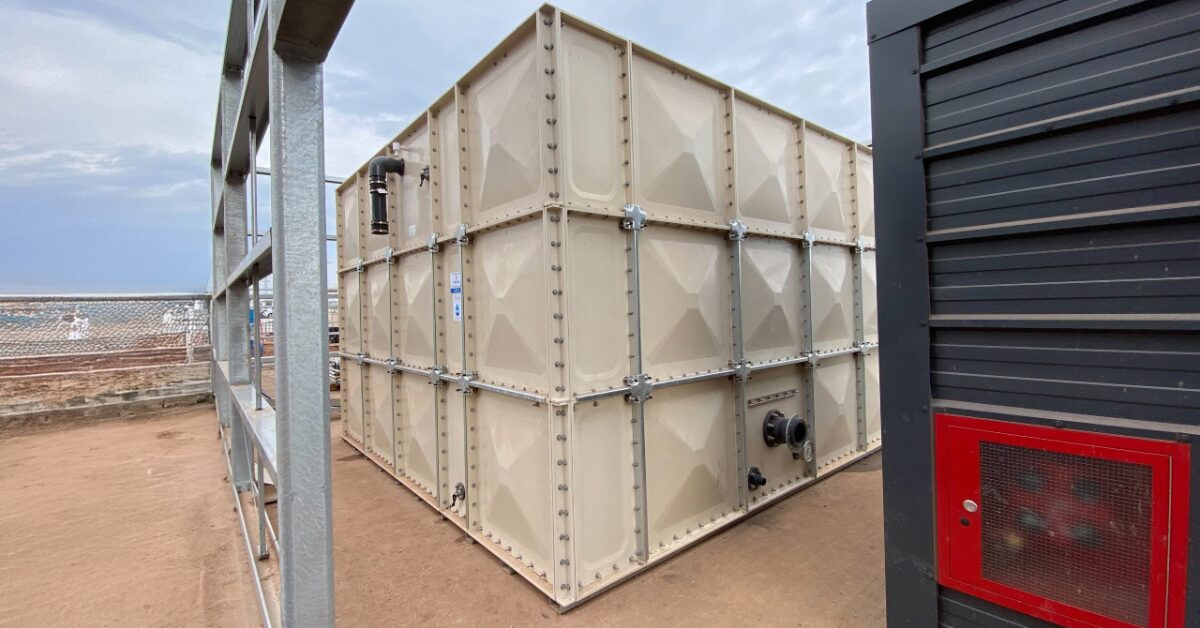
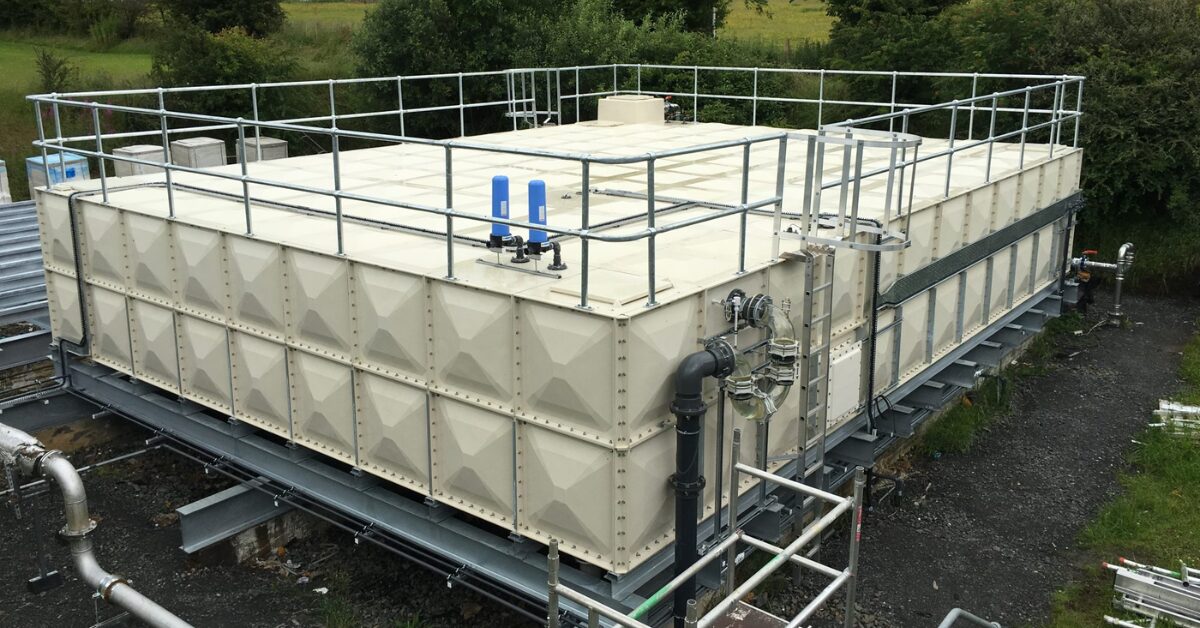
  • Segmented/compartmented GRP arrays enable phased builds and maintenance without losing capacity.  
  • BMS instrumentation: level (ultrasonic/radar), flow (electromagnetic), pH/conductivity/turbidity, leak detection; alarms at operational thresholds.  
  • Climate adaptation: review capacity every 3–5 years; consider 20–30% buffers and rainwater harvesting (potential 15–30% offset) where viable.  

Q&A

Size for peak temperature demand, not average daily use; adiabatic draw spikes during heatwaves. 

Yes, but clearly mark and protect the dedicated fire volume; insurers often expect LPCB aligned documentation. 

It’s a strong target (24–48h typical). Consider ≥72h where mains reliability or tanker access is uncertain. 

Every 3–5 years or after major plant/cooling changes; include climate stress scenarios. 

Sources

  1. Ponemon Institute (2023). Cost of Data Center Outages. Traverse City, MI: Ponemon Institute LLC. 
  2. UK Environment Agency. Water Resources Planning. Available at: https://www.gov.uk/government/organisations/environment-agency 
  3. Health and Safety Executive. Legionnaires’ disease: The control of legionella bacteria in water systems (L8). HSE Books. 
  4. British Standards Institution. BS 8558:2015 Guide to the design, installation, testing and maintenance of services supplying water for domestic use within buildings and their curtilages. London: BSI. 
  5. Met Office. UK Climate Averages. Available at: https://www.metoffice.gov.uk 

Read More...

  • Water Tank Installation & Maintenance
  • Cold Water Storage Tanks
  • Case Studies
Cold Water Tank Sizing

Cold Water Tank Sizing: How to Calculate Storage Volume for Multi-Storey Buildings

April 29, 2026

A technical guide to cold water tank sizing methodology for multi-storey buildings — covering demand estimation, resilience calculations, water age, Legionella risk, and a worked sizing example.

Confined Space Entry in Building Maintenance

Confined Space Entry in Building Maintenance: Obligations and Safe Systems

April 28, 2026

A practical guide to confined space entry obligations for building maintenance teams and contractors — covering the Confined Spaces Regulations 1997, permit to work, atmospheric testing, standby arrangements, and cold water tank entry.

Backflow Prevention

Backflow Prevention in Building Water Systems: Fluid Categories and Device Selection

April 23, 2026

A technical guide to backflow prevention under the Water Fittings Regulations — fluid categories 1 to 5, device types for cold water cisterns, the Type AG air gap requirement, and common compliance failures.

cold water system commissioning

Cold Water System Commissioning: Cleaning and Disinfection to BS EN 806-5

April 21, 2026

A practical guide to cold water system commissioning, cleaning, and disinfection in line with BS EN 806-5. Covers procedure, chlorination residuals, flushing, clearance for service, and handover documentation.