
insightfulacute

We value your privacy

Our website uses cookies to enhance your experience. By continuing to use our website, you are agreeing to our use of cookies. Necessary cookies are always enabled. You can read more about our Cookie Policy in our Privacy policy

We value your privacy

Cookies are small text files stored on your computer by websites you visit. They help users navigate websites efficiently and enable certain essential functions. Cookies necessary for the website to function properly can be set without your consent, while all other cookies require your approval before being used in your browser.

Additionally, we use cookies to gather data for personalizing and evaluating the effectiveness of our advertising. For more information, please refer to the Google Privacy Policy.

You can find the list of all the cookies that we use on our website here.

Rainwater Harvesting Tanks

Rainwater harvesting tanks

Rainwater Harvesting Tanks

What is a Rainwater Harvesting Tank?

Rainwater harvesting tanks have emerged as a critical solution for sustainable water management, particularly in areas of water scarcity. The concept revolves around collecting, storing, and using rainwater for various applications, ranging from irrigation to potable uses.

Benefits of Rainwater Harvesting Tanks

At Tricel, we have years of experience working with rainwater specialists. We can provide water storage solutions for drinking water (potable water), food preparation, irrigation, and sanitation, amongst other applications. We specialise in both boosted and gravity systems, and for specific sectional rainwater tank applications, please email our expert sales team with your exact requirements, and we can quote to suit.

  1. Water Conservation

Rainwater harvesting significantly lessens the strain on local water supplies, substantially conserving freshwater resources. This is especially beneficial in regions with limited water availability.

  1. Cost Savings

Property owners or businesses can considerably lower their water bills by utilising harvested rainwater for non-potable purposes such as irrigation and flushing toilets. Over time, the savings can offset the initial investment in the harvesting system. A property with an installed rainwater harvesting system can save between 40% and 50% on their water bills.

  1. Environmental Impact

Reducing runoff by collecting rainwater helps reduce the risk of flooding and erosion. Moreover, it decreases the burden on stormwater systems, which can be overwhelmed during heavy rains.

  1. Quality of Water

Rainwater is generally free from pollutants found in ground or surface water. When properly filtered and treated, it can be used for drinking and cooking, providing a cleaner alternative to other water sources.

Rainwater harvesting tanks Applications

Rainwater Harvesting Tanks

Harvesting tanks are versatile and can be utilised in various scenarios, including:

  1. Residential Properties

Residential properties can install rainwater tanks on the roof to collect water. This water can be used for potable and non-potable applications such as drinking water, gardening, and flushing toilets.

  1. Commercial Buildings

Businesses can benefit from large-scale rainwater harvesting systems to reduce water usage and enhance sustainability practices. This is particularly useful for office buildings, hotels, shopping centres, and industrial facilities.

  1. Agricultural Applications

Farmers can use harvested rainwater for irrigation, reducing their reliance on groundwater and ensuring a more sustainable farming practice.

Installation Locations for Rainwater Harvesting Tanks

The installation location of rainwater harvesting tanks plays a crucial role in the efficiency and effectiveness of the system. Here are some common installation locations:

  • Above-Ground Installations: Above-ground tanks are easy to install and maintain. They are ideal for locations where space is not restricted and can be integrated into the surroundings.
  • Loft Installations: Loft tanks are suitable for properties with limited outdoor space. They take advantage of unused attic space, though structural integrity must be assessed to ensure the loft can support the water tank’s weight when full.
  • Basement Installations: Basement tanks utilise space that might otherwise go unused. They offer easy maintenance access and can be integrated into existing building designs.

Ideal Solutions for Rainwater Harvesting

Sectional Tanks

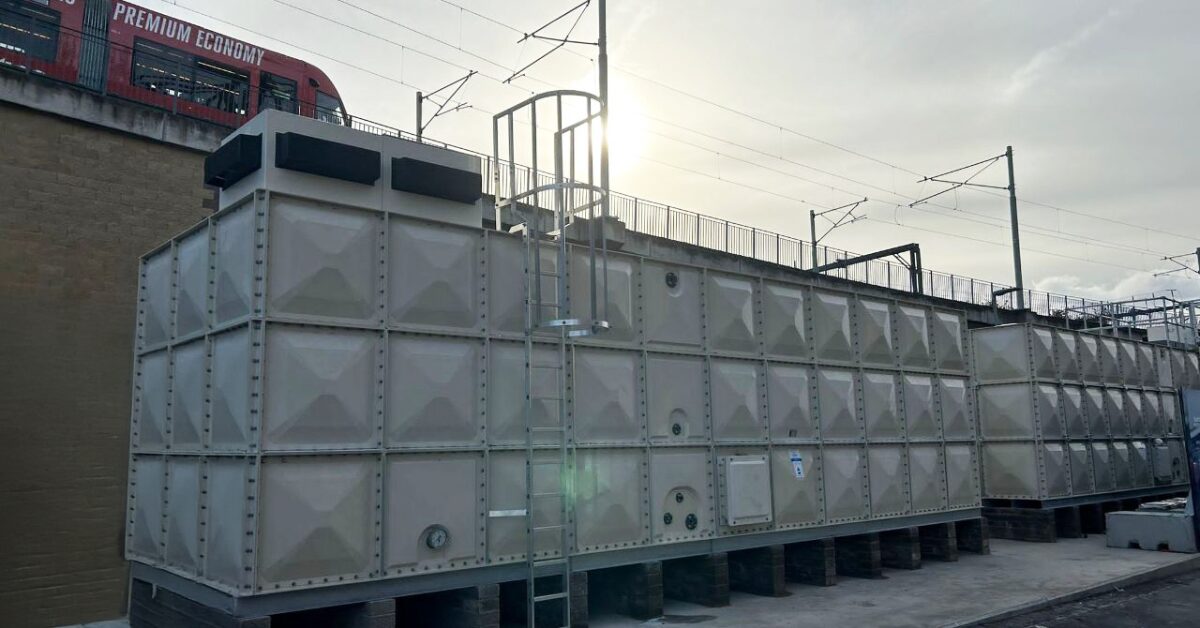
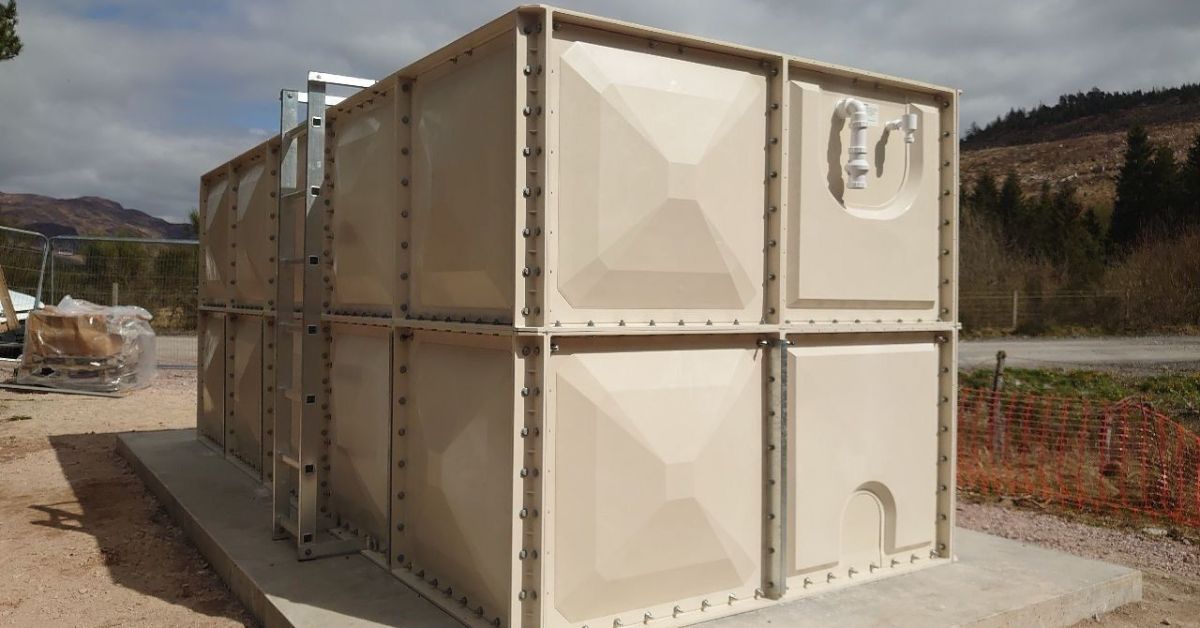
Sectional tanks are modular systems that can be palletised and assembled on-site, making them suitable for large-scale installations where transporting pre-assembled tanks would be challenging. Our sectional tanks offer high capacity and durability, which is ideal for commercial and industrial applications.

TIF Tanks

Totally internally flanged tanks with no base-to-side joints or external corner joints – making them 100% buildable from the inside, unlike other internally flanged or externally flanged tanks.

A successful rainwater harvesting system example comes from Tricel’s installation at a commercial facility. They installed a large-scale rainwater harvesting tank to collect and store rainwater for non-potable uses.

Project Overview

Our client needed a rainwater harvesting tank with a usable capacity of 5,200 litres. From the start, they provided a detailed brief for the rainwater tank required for the new housing development. On installation day, the plant room posed a challenge as it was 250mm short in one direction.

Outcome

To address the limited space in the plant room, we specified an L-shaped TIF tank to ensure proper and safe installation and maintenance. Thanks to our versatile panels, we swapped two 500mm panels for a 750mm section, reducing the initial capacity loss by 50%.

Conclusion

Rainwater harvesting tanks provide significant benefits, including water conservation and cost savings, for residential, commercial, and agricultural use. By utilizing natural rainfall, you can cut water consumption and costs while supporting environmental conservation. If your next project requires a rainwater harvesting tank, email your project details to our sales team at websales@tricelwater.co.uk.

Read More...

  • Cold Water Storage Tanks
  • Case Studies
Cold Water Tank Sizing

Cold Water Tank Sizing: How to Calculate Storage Volume for Multi-Storey Buildings

April 29, 2026

A technical guide to cold water tank sizing methodology for multi-storey buildings — covering demand estimation, resilience calculations, water age, Legionella risk, and a worked sizing example.

Confined Space Entry in Building Maintenance

Confined Space Entry in Building Maintenance: Obligations and Safe Systems

April 28, 2026

A practical guide to confined space entry obligations for building maintenance teams and contractors — covering the Confined Spaces Regulations 1997, permit to work, atmospheric testing, standby arrangements, and cold water tank entry.

Backflow Prevention

Backflow Prevention in Building Water Systems: Fluid Categories and Device Selection

April 23, 2026

A technical guide to backflow prevention under the Water Fittings Regulations — fluid categories 1 to 5, device types for cold water cisterns, the Type AG air gap requirement, and common compliance failures.

cold water system commissioning

Cold Water System Commissioning: Cleaning and Disinfection to BS EN 806-5

April 21, 2026

A practical guide to cold water system commissioning, cleaning, and disinfection in line with BS EN 806-5. Covers procedure, chlorination residuals, flushing, clearance for service, and handover documentation.

up