GRP Water Storage Tanks for UK Data Centres: The Most Reliable Choice for Cooling and Fire Resilience

GRP Water Storage Tanks for UK Data Centres

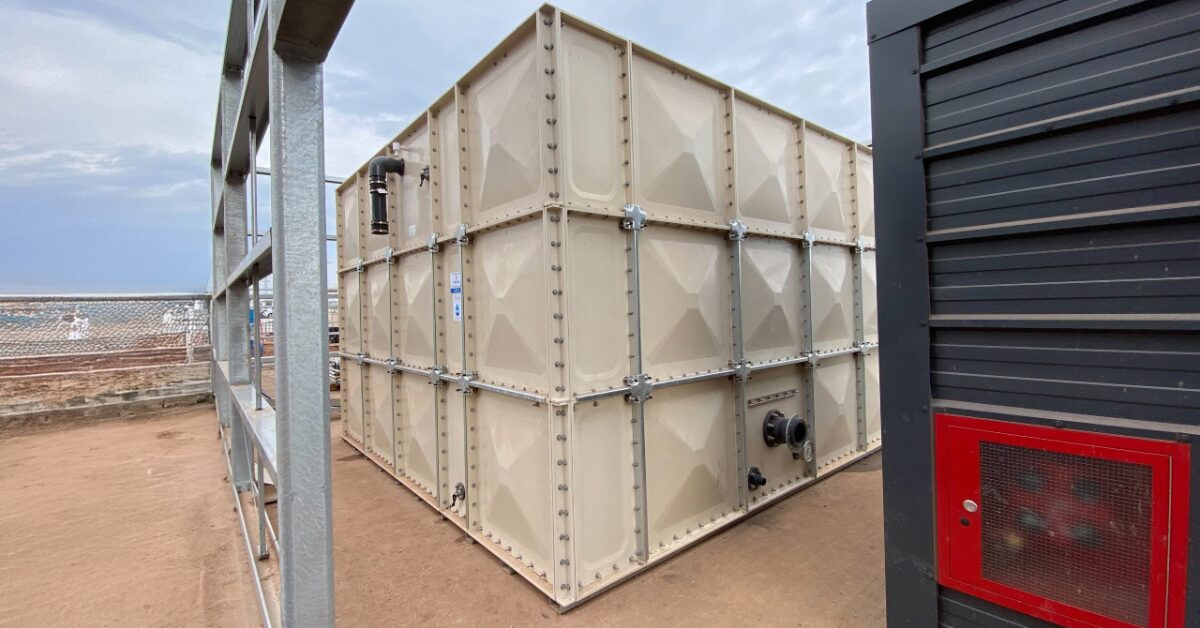
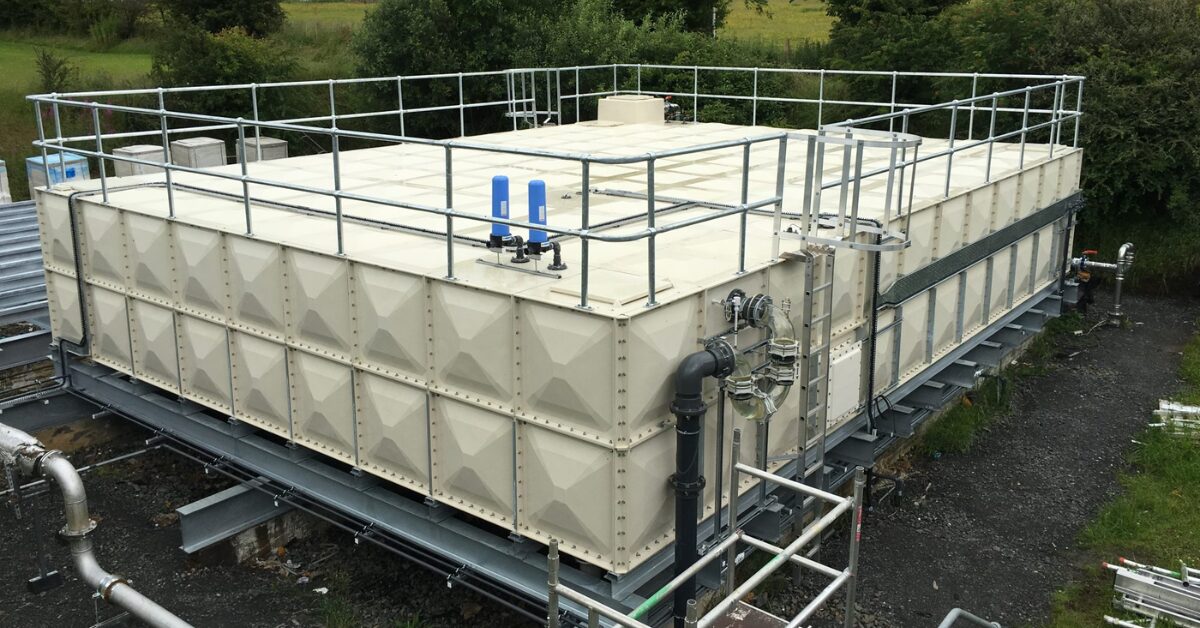
Data Centre GRP Tanks Installation:

For UK data centresGRP delivers 25 – 30 year lifespan, low maintenancelightweight panels for constrained spaces, WRAS/BS EN 13280 potable compliance, and LPCB aligned options for fire storage—at ~£200–£400/m³. Modular build enables weekend installation and redundancy via multi tank arrays. 

Why material selection matters

Your tank material influences lifecycle cost, hygiene, structural loads, installation time, and insurance acceptance. The Tricel Guide shows GRP as the optimal choice for most datacentre applications because it combines long service life, corrosion immunity, low weight, and modularity with UK approvals. 

GRP vs alternatives

  • GRP (GlassReinforced Plastic): 25–30 years~£200–£400/m³very low maintenance15–25 kg/m³, ideal for cooling/fire storage 
  • Coated steel: 15–20 years£300–£500/m³, higher maintenance and corrosion risk 
  • Concrete: 50+ years£400–£700/m³, heavy and suited to large belowground builds.  
  • Stainless steel: 30–40 years£600–£900/m³, premium for potable/hygienic duties.  

Compliance & assurance

  • Potable storageWRAS/Regulation 4(1)(a) approvals; BS EN 13280 for coldwater storage.  
  • Hygiene & Legionella: Follow BS 8558 + HSE L8 regimes; GRP designs support sealed lids, screened vents, and appropriate linings.  
CHECKLIST

Water System Specification Checklist for Data Centres

This System Specification Checklist provides a comprehensive framework for designing or procuring water storage solutions for data centres. From capacity sizing to hydraulic design, treatment systems, certifications, and monitoring, it ensures every critical requirement is captured. 

water resilience assessment checklist

Installation advantages of sectional GRP

  • Modular panels pass through standard doorways; ideal for retrofit plant rooms (IFB/EFB/TIF formats).  
  • Fast build3–10 days for 18–500 m³; larger arrays in 2–4 weeks; many projects complete over a single weekend shutdown 
  • Designed for redundancy: easy to configure multi tank arrays (compartmented or parallel) to eliminate single points of failure.  

Procurement checklist

  • Duty (cooling/fire/potable), autonomy hours, and required total m³ 
  • Compliance: Reg.4/WRAS (potable), BS EN 12845 (fire), LPCB/LPS (if insurerrequired), BS EN 1717 airgap/backflow.  
  • Configuration: sectional IFB/EFB/TIF, headroom limits, base steels, compartments 
  • Instrumentation: level/flow/quality sensors, leak detection, BMS protocols (Modbus/BACnet/SNMP).  
  • Maintenance plan: inspection/testing schedule (weekly/monthly/quarterly/annual), cleaning access, recordkeeping (HSE/BS). 


Download the editable Water System Specification Checklist for UK Data Centres for free. 

Frequently Asked Questions

Yes insulated covers, screened vents, and encapsulated foam help maintain temperature and hygiene; EFB designs allow fully self draining bases. 

From 1,000 L to multi million litres, with height limits and panel increments to suit the space; no restriction on plan dimensions for sectional assemblies.  

Typical installations: 3–10 days (18–500 m³) or 2–4 weeks (500–5,000 m³), plus commissioning/testing and operator training. 

It’s excellent for potable/hygienic duties but carries higher capital cost and weight than GRP; for cooling/fire storage, GRP typically provides the best lifecycle value

Yes modular GRP supports phased capacity growth and retrofits without major structural works

Sources

  1. Ponemon Institute (2023). Cost of Data Center Outages. Traverse City, MI: Ponemon Institute LLC. 
  2. UK Environment Agency. Water Resources Planning. Available at: https://www.gov.uk/government/organisations/environment-agency 
  3. Health and Safety Executive. Legionnaires’ disease: The control of legionella bacteria in water systems (L8). HSE Books. 
  4. British Standards Institution. BS 8558:2015 Guide to the design, installation, testing and maintenance of services supplying water for domestic use within buildings and their curtilages. London: BSI. 
  5. Met Office. UK Climate Averages. Available at: https://www.metoffice.gov.uk 

Read More...

  • Water Tank Installation & Maintenance
  • Cold Water Storage Tanks
  • Case Studies
Cold Water Tank Sizing

Cold Water Tank Sizing: How to Calculate Storage Volume for Multi-Storey Buildings

April 29, 2026

A technical guide to cold water tank sizing methodology for multi-storey buildings — covering demand estimation, resilience calculations, water age, Legionella risk, and a worked sizing example.

Confined Space Entry in Building Maintenance

Confined Space Entry in Building Maintenance: Obligations and Safe Systems

April 28, 2026

A practical guide to confined space entry obligations for building maintenance teams and contractors — covering the Confined Spaces Regulations 1997, permit to work, atmospheric testing, standby arrangements, and cold water tank entry.

Backflow Prevention

Backflow Prevention in Building Water Systems: Fluid Categories and Device Selection

April 23, 2026

A technical guide to backflow prevention under the Water Fittings Regulations — fluid categories 1 to 5, device types for cold water cisterns, the Type AG air gap requirement, and common compliance failures.

cold water system commissioning

Cold Water System Commissioning: Cleaning and Disinfection to BS EN 806-5

April 21, 2026

A practical guide to cold water system commissioning, cleaning, and disinfection in line with BS EN 806-5. Covers procedure, chlorination residuals, flushing, clearance for service, and handover documentation.