Home » Sectional Tanks
GRP Sectional Tanks for Cold Water Storage
Tricel manufactures hot-press moulded GRP sectional water tanks from 1,000 to over 4 million litres. Site-assembled from modular panels, they are suited to restricted-access plant rooms, large-capacity commercial installations and retrofit projects across the UK.
- •Hot-press moulded GRP panels – consistent dimensional accuracy and full cure
- •EFB, IFB and TIF configurations – including options for constrained plant rooms
- •Regulation 4(1)a and WRAS-approved tanks for potable cold water storage
- •Site assembly by Tricel-trained installation teams across the UK
GRP Sectional Tank — Key Parameters

Capacity range
1,000 L – 4M+ litres
Configurations
EFB / IFB / TIF
Panel construction
Hot-press moulded GRP
Approval
Regulation 4(1)a / WRAS
Installation
Internal or external
Assembly
Tricel-trained site crews, UK
What are GRP sectional tanks?
GRP sectional water tanks are modular cold water storage tanks made from hot-press moulded glass reinforced plastic panels. Panels are transported to site individually and assembled by trained operatives, allowing installation where a complete tank unit cannot be delivered or positioned. Tricel manufactures GRP sectional tanks in EFB, IFB and TIF configurations, with capacities from 1,000 to over 4 million litres, for commercial, industrial and infrastructure cold water storage applications across the UK. Tanks are available with Regulation 4(1)a and WRAS-approved options for potable cold water storage.
Tricel - GRP Tank Manufacturer
Made by the manufacturer, not a distributor
Tricel manufactures GRP sectional tanks at production facilities in Weston-super-Mare and Lanark. Panels are hot-press moulded in-house under strict quality control procedures and assembled by Tricel-trained installation teams. There is no third-party intermediary between the manufacturing process and the project.
This matters for specifiers and engineers: when a product question arises during design, you are speaking with the people who make the tank, not a reseller interpreting a manufacturer’s datasheet.
Litres maximum capacity
Standard hot-press panel size
Potable approval
UK manufacturing sites
Step 01
Hot-press moulding
GRP panels are moulded under heat and pressure using isophthalic polyester resin and glass fibre reinforcement, producing consistent dimensional accuracy and full cure on both panel faces.
Step 02
Quality control
Strict QC procedures are applied at each moulding stage. Materials used in potable water tank production are tested for compliance with Regulation 4(1)a and WRAS requirements.
Step 03
Palletised delivery
Panels are palletised and delivered to site. Individual panel dimensions allow transportation via standard access routes, including stairwells, narrow corridors and goods lifts.
Step 04
Site assembly
Tanks are assembled on the prepared base by Tricel-trained installation crews. Assembly method depends on tank type: EFB and IFB are assembled externally; TIF tanks are assembled from inside.
Regulation 4(1)a Approved
NSF-approved tanks for potable cold water storage where specified
WRAS-Compatible Options
Components and fittings available to WRAS specification where required
BS EN 13280 Reference Standard
Panels manufactured with reference to British and European cold water storage standards
Free Site Surveys Available
Subject to location — confirm suitability before specifying
01
Applications
Where GRP Sectional Tanks Are Specified
Sectional GRP water tanks are specified across a wide range of building types, infrastructure projects and industries. Common to most applications is a requirement to balance storage capacity, installation access and long-term maintenance provision.
Healthcare & NHS
High-Rise & Multi-Storey
Infrastructure & Utilities
Fire Protection
Data Centres
Industrial & Manufacturing
Education
Agriculture
Food & Beverage
Local Authority & Public
02
Why Sectional GRP
Where GRP Sectional Tanks Are Specified
The following characteristics make GRP sectional tanks a specification consideration for a range of commercial and industrial projects. Each project should be assessed on its specific access, capacity and compliance requirements.
01
Site assembly from modular GRP panels
Panels are transported individually and bolted together on site. This allows tanks to be installed in locations inaccessible to complete tank units — including upper-floor plant rooms, basement vaults and buildings with constrained doorways or stairwells.
02
Restricted-access and retrofit suitability
Because individual panels are manageable in size and weight, sectional GRP tanks can be installed via routes where one-piece tanks cannot be positioned. For replacement projects, an existing tank can be dismantled panel by panel and a new tank assembled in the same space.
03
Capacity from 1,000 L to over 4 million litres
Tank capacity is constrained by available footprint and headroom, not by a fixed maximum product size. The panel grid can be extended to accommodate larger storage volumes as required by the project demand calculation.
04
Internal and external installation
GRP sectional tanks are suitable for plant room installation and external installation. External tanks require insulation and weatherproofing appropriate to the site conditions and the storage use, which should be specified at design stage.
05
Potable water suitability where specified
Tricel manufactures Regulation 4(1)a approved GRP sectional tanks for potable cold water storage. Compliance depends on the full specification, including WRAS-approved fittings, pipework arrangement, insulation, access provision and the maintenance regime. Specify potable use at the quotation stage.
06
Hot-press moulded panels — consistent quality
Hot-press moulding produces panels with uniform wall thickness, accurate dimensions and smooth surfaces on both faces. Consistent panel geometry simplifies site assembly and helps maintain seal integrity across the bolted joint interfaces.
03
Tank Types
GRP Sectional Tank Types: EFB, IFB and TIF
Tricel manufactures four types of GRP sectional water tank. The appropriate type depends on available headroom, perimeter clearance, access route, pipework position and maintenance requirements. All three types use hot-press moulded GRP panels.
|
Tank Type
|
Best for
|
Key Advantage
|
Primary Constraint
|
Approval
|
|---|---|---|---|---|
|
EFB - External Flanged Base
|
Open-access sites with standard perimeter clearance and adequate headroom
|
Raised self-draining base; ideal for cleaning and maintenance access below the tank
|
Requires clearance around perimeter and below base frame; higher overall installation height than IFB
|
Reg. 4(1)a
|
|
IFB - Internal Flanged Base
|
Sites where headroom is limited and a lower overall tank height is required
|
Lower installation height than EFB; can be built on flat base or levelled steel beams
|
Perimeter access for inspection and maintenance must still be maintained; hatch clearance applies
|
Reg. 4(1)a
|
|
TIF - Totally Internally Flanged
|
Constrained plant rooms and retrofit environments where external perimeter clearance is highly limited
|
Assembled from inside; approximately 50mm clearance achievable on three sides — removes the external assembly clearance requirement
|
Approximately 500mm required on one side for pipework access; internal assembly by trained operatives
|
NSF Reg. 4(1)a
|
Tank Type Selection — Indicative Decision Framework
The following is indicative guidance only. Each project should be assessed individually at design stage.
IF
The site has clear perimeter access and standard headroom — consider EFB. The raised self-draining base supports cleaning and maintenance and is the most straightforward configuration where space permits.
IF
Headroom is limited and a lower tank height is a requirement — consider IFB. Perimeter access for inspection and maintenance must still be maintained regardless of tank height.
IF
Perimeter access is highly restricted on multiple sides — consider TIF. Approximately 500mm clearance on the pipework access side is required; three other sides can be as close as approximately 50mm subject to design confirmation.
IF
Replacing an existing tank in a tight plant room — confirm access route, pipework side, base condition and base tolerance first. An early technical review by Tricel will identify constraints before specification is fixed.
04
TIF Tanks
TIF GRP Sectional Tanks for Restricted Plant Rooms
TIF tanks are designed for constrained plant rooms and direct replacement projects where external clearance on multiple sides is not achievable. Assembly is carried out from inside the tank by Tricel-trained operatives, which removes the need for standard external perimeter clearance during construction.
Tricel’s TIF tanks are NSF Regulation 4(1)a approved and custom-designed for each project, making them suitable for high-rise, dense urban and healthcare estates where standard clearance is not available.
Assembled from inside the tank; trained operatives work within the panel structure
Approximately 50mm clearance achievable on three sides — subject to project design confirmation
Approximately 500mm clearance required on one side for pipework access and future maintenance
Custom-designed per project; suitable for high-rise, healthcare, dense urban and retrofit installations
NSF Regulation 4(1)a approved — suitable for potable cold water storage where specified
Clearance values are indicative design guidance. They must be confirmed at design stage and may vary depending on tank configuration, pipework routing and maintenance access strategy. Do not use these values as the sole basis for plant room layout without technical review.
05
Tank & Panel Sizes
GRP Sectional Tank and Panel Sizes
GRP sectional water tank capacity is determined by panel configuration, available footprint and headroom. Tricel’s standard hot-press moulded panels are 1m units; the panel grid defines the tank’s external dimensions. Full panel size and capacity tables are available in the dedicated sizes reference.
Tricel Tank & Panel Sizes Guide
Full capacity tables and panel configurations
The Tricel tank and panel sizes reference sets out standard panel dimensions, available capacity ranges and configuration options. Use it alongside your project footprint and headroom to identify a viable starting configuration before requesting a formal quotation.
Bespoke panel configurations are available for non-standard dimensions; confirm requirements at enquiry stage.
Specification Input — Project Variables
Required capacity
Project-specific (litres)
Nominal capacity
Confirmed at design stage
Actual capacity
Confirmed at design stage
Usable capacity
Depends on float valve position
Panel layout (L × W × H)
Per project footprint & headroom
Access hatch position
Top panel — project-specific
Base type
EFB / IFB / TIF — per specification
All values are inputs to the specification process and must be confirmed against the specific project requirements. No standard size should be assumed without consulting the panel sizes reference.
06
How to Size a GRP Sectional Tank
How to Size a GRP Sectional Water Tank
Start with demand, not only available space. The required storage volume is calculated from building use, occupancy, demand profile and resilience requirements. Available footprint and headroom then constrain the panel configuration. Both factors must be resolved before a configuration can be confirmed.
Maintenance frequency schedule
Sizing calculators
Required storage volume (litres)
Building use and occupancy type
Demand profile — peak flow and daily demand
Resilience and standby requirement (hours or days)
Available footprint (L × W, metres)
Available headroom (metres)
Access route constraints to the plant room
Maintenance and cleaning access requirements
Water turnover rate
Potable or non-potable use
Fire reserve or sprinkler volume requirement
Insulation requirement (internal / external)
Water Tank Size Calculator
Estimate storage volume from demand data and occupancy
Water Tank Capacity Calculator
Calculate usable capacity from tank dimensions and panel layout
Sprinkler / Wet Riser Calculator
Fire reserve storage sizing for sprinkler and wet riser systems
Calculators provide indicative estimates. A formal Tricel quotation includes a reviewed tank configuration based on your specific project requirements.
07
Installation
Installation and Clearance Requirements for GRP Sectional Tanks
Installation planning for GRP sectional tanks should address access route dimensions, base preparation, headroom, pipework clearance, hatch access and perimeter maintenance clearance. The values below are indicative design guidance only and must be confirmed at design stage against the specific tank type and project configuration.
|
Clearance / Requirement
|
Indicative Guidance
|
Notes
|
|---|---|---|
|
IFB hatch clearance — hinged lid
|
750 mm
|
Required above the hatch opening for inspection and entry access
|
|
IFB hatch clearance — lift-off hatch
|
500 mm
|
Where a lift-off hatch is specified in place of a hinged lid
|
|
Perimeter clearance — tanks up to 2m high
|
500 mm
|
All sides, for inspection, cleaning and maintenance access
|
|
Perimeter clearance — 2.5–3m high tanks
|
800 mm
|
Increased clearance required for working at height in the clearance zone
|
|
Perimeter clearance — 3.5–4m high tanks
|
1,000 mm
|
Larger clearance required for taller configurations; confirm at design stage
|
|
TIF — pipework access side
|
~500 mm
|
One side must allow pipework connection and future maintenance access
|
|
TIF — remaining three sides
|
~50 mm
|
Minimal clearance achievable on the three non-pipework sides; subject to design confirmation
|
|
Base flatness tolerance
|
2 mm per 1 m / 6 mm per 6 m
|
The prepared base must be flat within these tolerances to ensure panel alignment and joint seal integrity across the full tank footprint
|
These are indicative design guidance values only – not universal regulatory requirements. Clearance requirements must be confirmed against the specific tank type, panel configuration, pipework routing and maintenance access strategy for each project. Do not use these figures as the sole basis for plant room layout without reference to current Tricel installation guidelines and a technical review of the specific project.
Base preparation
Base condition and tolerance
The base must be flat, level and structurally capable of supporting the full loaded weight of the tank. Base flatness tolerance is 2mm per 1m and 6mm per 6m. IFB tanks can be supported on flat concrete, levelled steel beams or pier walls. EFB tanks require a base frame appropriate to the tank layout.
Access route
Panel delivery and accesscified
Individual GRP panels must be transported from the delivery vehicle to the installation point via the available access route. Door widths, stairwell dimensions, lift capacity and floor loading along the route should be confirmed before delivery is scheduled.
Maintenance access
Inspection and cleaning
Perimeter clearance must be maintained throughout the life of the tank for inspection, cleaning and regulatory compliance. Access hatch size and position should be agreed at design stage to ensure the tank can be fully inspected and cleaned as required by water hygiene guidance.
08
Compliance & Water Hygiene
Compliance and Water Hygiene for GRP Sectional Tanks
For cold water storage intended for potable use, the specification must address water regulations, material compliance, water quality management and maintenance access. Compliance is determined by the complete system specification, not by the tank alone.
Regulatory and specification considerations
|
Reg/Spec
|
Description
|
|---|---|
|
Water Supply (Water Fittings) Regulations 1999
|
applicable to systems connected to the public mains supply
|
|
Regulation 4(1)a (NSF) approval
|
Tricel manufactures tanks to this standard for potable cold water storage where required
|
|
WRAS approval
|
WRAS-approved components and fittings available where specified; confirm requirements at quotation stage
|
|
BS EN 13280:2001
|
reference standard for GRP cold water storage tanks; panels manufactured with reference to this standard
|
|
Inspection and cleaning access
|
hatch size, hatch position and perimeter clearance must support routine maintenance
|
|
Drainage arrangements
|
the tank must be capable of full draining for cleaning and inspection
|
|
Insulation
|
required to maintain water temperature below 20°C (cold supply) and support Legionella risk management
|
|
Water turnover
|
adequate throughput should be maintained to reduce stagnation risk
|
|
Legionella risk management
|
in accordance with HSE L8 and the ACOP guidance; water hygiene consultant review recommended for potable systems
|
Design for compliance, maintenance and water quality
Compliance with water regulations is not achieved by the tank specification alone. It depends on the full system design: tank type, materials, fittings, pipework arrangement, insulation, access provision and the ongoing maintenance regime.
Consulting engineers and water hygiene consultants should review the specification against the relevant regulatory framework for the intended use before the design is finalised.
Where WRAS-approved components or Regulation 4 compliance is required, this must be specified at the quotation stage. Not all configurations or fittings carry these approvals as standard.
Tricel offers free site surveys (subject to location) to review access, base conditions and clearance requirements before specification is confirmed.
09
Cold Water Storage Tank Aftercare
Cold Water Storage Tank Aftercare Services
Installing a GRP sectional tank creates a long-term water hygiene obligation. Under HSE ACoP L8 and HSG274, building owners and responsible persons have a legal duty to maintain cold water storage in a hygienic, safe and documented condition throughout the life of the tank.
Tricel Water UK has partnered with Hydraclean Ltd – a leading Water Hygiene and Legionella Compliance specialist – to provide a complete aftercare service for GRP sectional tanks. All three services below are delivered by Hydraclean and are fully compliant with ACoP L8, HSG274 and BS8558:2015.
HSG274 & ACoP L8
Tank Inspection
Regular inspections are required to ensure ongoing compliance with HSG274 and ACoP L8. Best practice is every six months; the minimum requirement is annually. Inspections are carried out by suitably trained and competent operatives.
Regulatory and specification considerations
- Incoming mains and stored water temperatures
- Stored water must be below 20°C for cold supply
- Condition of insect and vermin screen
- Sediment and debris levels
- Stagnation risk and osmosis status
- Identification of any required remedial works
BS8558:2015
Cleaning & Chlorination
Over time, tanks accumulate dust, sediment, rust, organic matter and other contaminants that encourage biofilm formation and bacterial growth. Routine cleaning to BS8558:2015 prevents contamination from incoming mains debris and ensures tanks remain safe, clean and compliant.
Cleaning process includes
- Full risk assessment prior to commencement
- Safe access including confined space protocols
- Tank isolation, drainage and booster pump isolation
- Manual cleaning of all internal surfaces
- Optional full chemical disinfection where required
- Photographic records before and after works
UKAS-Accredited Testing
Legionella & Microbiological Sampling
Water sampling is a critical component of any Legionella control programme. Where cold water storage tanks supply potable water, sampling ensures water quality remains at mains standard and safe for consumption. All samples are analysed by independent UKAS-accredited laboratories.
Sampling is particularly important where
- Storage or distribution temperatures are elevated
- Correct temperatures are not being achieved
- A Legionella outbreak is suspected
- Occupants are at heightened risk (hospitals, care homes)
- The risk assessment recommends microbiological sampling
|
Standard / Guidance
|
Scope
|
Key Requirement
|
Applies To
|
|---|---|---|---|
|
ACoP L8
|
HSE Approved Code of Practice — Legionella
|
Legal duty to assess and manage Legionella risk in water systems; maintain written records of all control measures
|
All buildings with a cooling system or water storage serving vulnerable populations or the public
|
|
HSG274 Part 2
|
HSE Technical Guidance — Cold Water Systems
|
Inspection and monitoring of cold water storage tanks; stored water must be maintained below 20°C; annual inspection minimum, 6-monthly best practice
|
All cold water storage tanks in commercial, industrial and residential buildings
|
|
BS 8558:2015
|
Design, installation, testing and maintenance of water systems
|
Sets out requirements for cleaning and disinfection of cold water storage systems, including pre-commissioning, post-installation and routine maintenance
|
New installations and existing systems requiring cleaning or recommissioning
|
|
UKAS Accreditation
|
Laboratory accreditation for microbiological sampling
|
All microbiological samples should be analysed by a UKAS-accredited laboratory to ensure results are legally defensible
|
All microbiological samples should be analysed by a UKAS-accredited laboratory to ensure results are legally defensible
|
10
Technical Downloads
GRP Sectional Tank Technical Resources
Technical documents for engineers, specifiers and M&E contractors. Download for use in design, specification and project review.
GRP Sectional Tank Product Brochure
Overview of EFB, IFB and TIF configurations, capacity ranges, approvals and specification options.
IF Tank Technical Brochure
Overview of IF internally flanged hot press tanks, including configurations and installation benefits.
IFB Tank Technical Brochure
Specification summary for IFB internally flanged base tanks, covering design and application.
TIF Tank Technical Brochure
Detailed technical specification for TIF (Tank Internally Flanged) GRP sectional tanks for constrained plant rooms.
Confined Space Entry in Building Maintenance: Obligations and Safe Systems
Guide to confined space entry requirements, safety regulations and best practices.
GRP Cold Water Storage Whitepaper
Technical whitepaper covering GRP sectional tanks in UK infrastructure, design standards and maintenance guidance.
11
Specification Support
Specification Support for Engineers and M&E Contractors
Providing project information early reduces design revision and improves quotation accuracy. The following details are useful at the initial enquiry stage. Plant room drawings, existing tank details and access route information help identify constraints before specification is finalised.
Information required for a GRP sectional tank quotation
Required storage capacity (litres)
Tank location: internal or external
Available headroom
Preferred tank type (if known)
Pipework requirements
Potable or non-potable use
Project location
Available footprint (L × W)
Access route constraints
Base or support slab details
Insulation requirement
Plant room drawings or layout
Send project details to Tricel
Tricel’s technical sales team will review your project requirements and advise on a suitable GRP sectional tank configuration, including tank type, panel layout, base type and access strategy.
Free site surveys available subject to location. Confirm access, base condition and clearance requirements before specification is fixed.
12
Tank Comparison
GRP Sectional Tanks vs One-Piece vs Two-Part Water Tanks
The appropriate tank type depends on access, required capacity, plant room constraints and project programme. This table is for initial reference only; projects should be assessed on their specific requirements.
|
Requirement
|
GRP Sectional Tanks
|
One-Piece Tanks
|
Two-Part Tanks
|
|---|---|---|---|
|
Restricted access
|
Strong option: Panel-by-panel assembly; individual panels manoeuvred via stairwells, narrow corridors and restricted routes
|
Access-dependent: Requires a clear, continuous delivery path from the vehicle to the installation point
|
Partial: Two separate halves; suitable where both sections can be moved through the access route independently
|
|
Capacity range
|
Large and bespoke: Panel grid can be extended; capacity constrained by available footprint and headroom, not a product maximum
|
Standard range: Fixed sizes up to 16,000 litres; suitable where a standard capacity meets project requirements
|
Moderate range: Greater than one-piece; smaller than fully sectional configurations in most cases
|
|
Plant rooms
|
Well-suited: TIF option available for highly constrained plant rooms; EFB and IFB for standard access
|
Access-dependent: Doorways and routes must accept the complete tank unit as delivered
|
Depends on layout: Useful where doorways allow both halves to be moved in and joined on site
|
|
Replacement projects
|
Common choice: Existing tank dismantled panel by panel; replacement assembled in the same space
|
Access-dependent: Suitable only where the original tank was accessible as a complete unit
|
Useful mid-ground: Where access allows both sections to be moved through the available route
|
|
Programme
|
On-site assembly time dependent on tank size; palletised delivery to site
|
Shortest on-site programme; delivered complete and positioned via handling equipment
|
Intermediate; two sections joined on site
|
13
Project Experience
GRP Sectional Tank Project Experience
Tricel has installed GRP sectional water tanks across commercial, healthcare, industrial and infrastructure projects throughout the UK. The following represent the range of project types and constraints that Tricel’s sectional tank configurations have been applied to.

Special educational needs school — LPCB sprinkler tank
LPCB-approved sectional GRP sprinkler tank installed at a special educational needs school to BS EN 12845 and BS 9251. Installation completed with minimal disruption on a sensitive site with restricted access.
Infrastructure project — large-capacity GRP sectional tanks
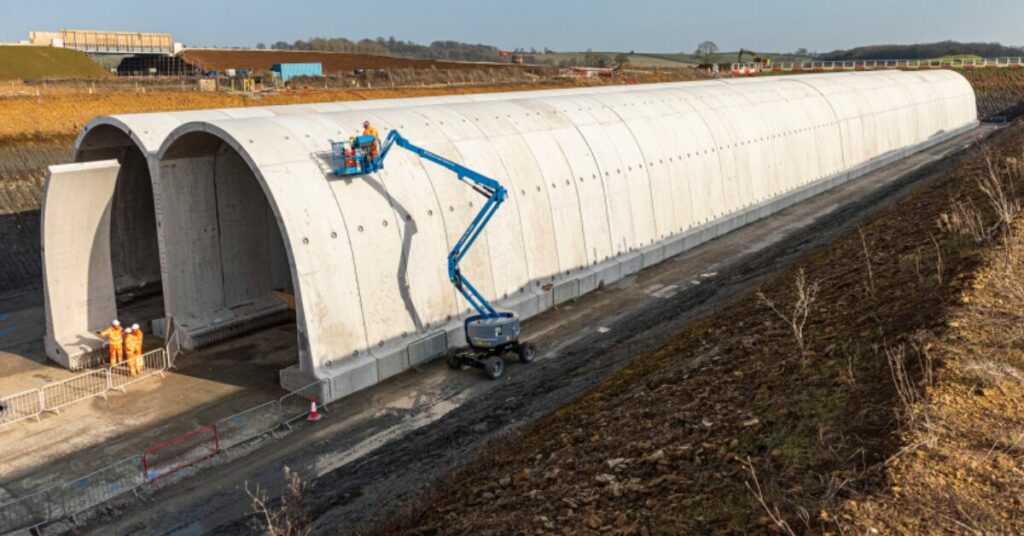
GRP water tanks (8m × 7m × 4m) manufactured and installed for two HS2 Green Tunnel sites at Greatworth and Chipping Warden, as part of the UK’s largest current infrastructure project.
Commercial building — 2 large potable water storage tanks
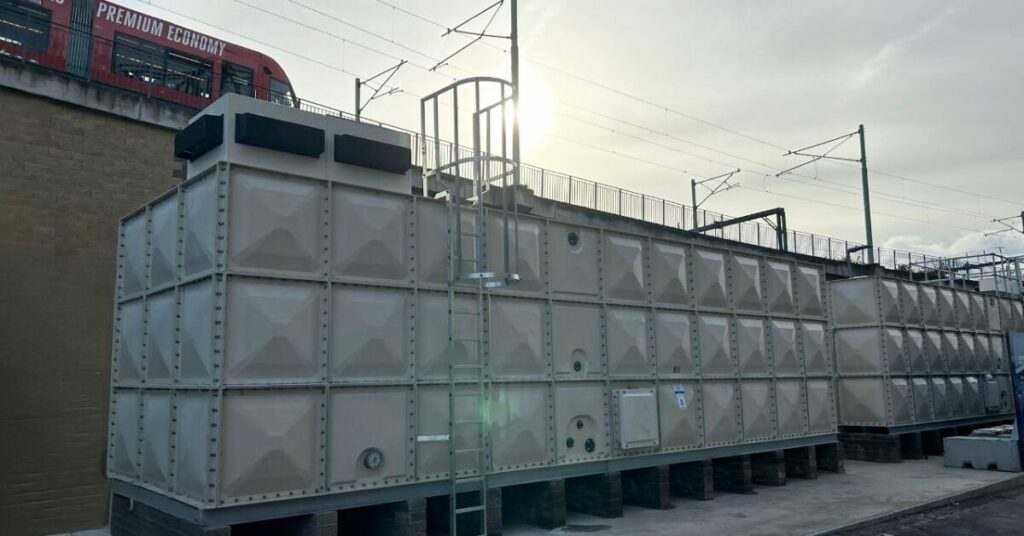
Two large GRP potable water storage tanks designed, manufactured and installed for Scottish Water Business Stream ahead of a major event. Completed ahead of schedule through close coordination between multiple stakeholders.
14
Related Resources
Plan Your GRP Sectional Tank Project
Relevant Tricel products, sizing tools, technical resources and compliance guidance for engineers, specifiers and M&E contractors.
Sectional Tank Configurations
Compliance & Aftercare
15
FAQs
GRP Sectional Water Tank FAQs
Common questions from consulting engineers, M&E contractors and specifiers.
What is a GRP sectional water tank?
A GRP sectional water tank is a modular cold water storage tank constructed from individual hot-press moulded glass reinforced plastic panels. Panels are transported to site separately and assembled by trained operatives, allowing installation in locations where a complete tank unit cannot be delivered or positioned — including upper-floor plant rooms, basements, high-rise buildings and restricted-access sites. Tricel manufactures GRP sectional water tanks in EFB, IFB and TIF configurations with Regulation 4(1)a and WRAS-approved options for potable cold water storage.
What sizes do GRP sectional tanks come in?
Tricel GRP sectional tanks are available from 1,000 litres to over 4 million litres. Tank size is determined by the panel grid configuration — Tricel’s standard hot-press moulded panels are 1m units — and constrained by available footprint, headroom and access route. There is no fixed maximum product size; capacity is extended by adding panels to the grid. Full panel size and capacity tables are set out in the Tricel water tank and panel sizes reference.
What is the difference between EFB, IFB and TIF GRP sectional tanks?
The three main GRP sectional tank types differ in base design, assembly method and the clearance they require:
- EFB (External Flanged Base) – raised self-draining base; suited to open-access sites with standard perimeter clearance and headroom; the most common configuration
- IFB (Internal Flanged Base) – lower overall installation height; suited to sites with limited headroom; perimeter maintenance clearance still required
- TIF (Tank Internally Flanged) – assembled from inside; approximately 50mm clearance achievable on three sides; approximately 500mm required on the pipework access side; suited to highly constrained plant rooms and retrofit projects
Are GRP sectional tanks WRAS or Regulation 4 approved?
Tricel manufactures GRP sectional tanks to Regulation 4(1)a (NSF) approval for potable cold water storage. WRAS-approved components and fittings are available where specified. Compliance for potable use depends on the full specification — tank type, materials, pipework, fittings, insulation, access provision and the ongoing maintenance regime. Potable water use and any approval requirements should be stated at the quotation stage, as not all configurations or fittings carry these approvals as standard.
How much clearance does a GRP sectional tank require?
Clearance requirements vary by tank type and height. As indicative design guidance:
- Tanks up to 2m high – approximately 500mm perimeter clearance on all sides
- Tanks 2.5–3m high – approximately 800mm perimeter clearance
- Tanks 3.5–4m high – approximately 1,000mm perimeter clearance
- IFB hatch clearance – 750mm standard; 500mm with lift-off hatch
- TIF – approximately 50mm on three sides; approximately 500mm on the pipework access side
- Base flatness – 2mm per 1m; 6mm per 6m
All values are indicative design guidance only and must be confirmed at design stage against the specific tank type, configuration and project constraints.
Can GRP sectional tanks be used in restricted plant rooms?
Yes. The TIF (Tank Internally Flanged) configuration is designed specifically for constrained plant rooms where standard perimeter clearance is not achievable on multiple sides. TIF tanks are assembled from inside, removing the need for external perimeter access during construction. However, regardless of tank type, the access route for delivering panels, the base condition, the pipework side and the maintenance access strategy must all be confirmed at design stage. Tricel offers site surveys (subject to location) to assess these factors before specification is confirmed.
How are GRP sectional tanks manufactured?
Tricel GRP sectional tank panels are hot-press moulded at manufacturing facilities in Weston-super-Mare and Lanark. Hot-press moulding uses heat and pressure to cure GRP panels using isophthalic polyester resin and glass fibre reinforcement. The process produces panels with consistent dimensional accuracy, smooth surfaces on both faces and full cure throughout the panel thickness. Strict quality control procedures are applied during moulding. Materials used in potable water tank production are tested for Regulation 4(1)a and WRAS compliance.
What information is needed to get a GRP sectional tank quote from Tricel?
At a minimum: required storage capacity, project location, tank location (internal or external), available footprint and headroom, access route constraints, pipework requirements, insulation requirement and whether the use is potable or non-potable. Plant room drawings, existing tank details and the preferred tank type (if known) will help identify constraints earlier and improve the accuracy of the quotation. Send project details to websales@tricelwater.co.uk or call +44 (0)1934 421 499.
Specification Support — Tricel Technical Sales
Need a GRP sectional tank layout for your project?
Send your required capacity, plant room dimensions, access route constraints and available drawings. Tricel will review the project requirements and advise on a suitable GRP sectional tank configuration — including tank type, panel layout, base type and access strategy.
This product guide is provided for general guidance and information purposes only. It does not constitute engineering advice and should not be relied upon as the sole basis for design decisions. © 2026 Tricel Water. All rights reserved.